Wednesday, April 26, 2006

1956


trying to write the next Peyton Place

Ella Fitzgerald, Azure.
Cecil Taylor, Azure.


Duke Ellington's "Azure," which he composed and recorded in 1937, has one of Ellington's loveliest, most yearning melodies--built around the graceful movement of semi-tones, rising and falling gently, saturated with melancholy and wistfulness.

Ten days apart in September 1956, two musicians--Ella Fitzgerald, in the midst of consolidating her reputation as the premier vocal interpreter of jazz standards, and the young Cecil Taylor, in his first-ever recording date--each recorded a version of "Azure." Both are masterpieces, though unlike in a great many ways.

Fitzgerald's version, which she recorded as part of her "Duke Ellington Songbook" sessions, is impeccably sung--it might be my favorite Fitzgerald vocal. Incredibly phrased, Ella's vocal imbues each word with longing, mystery and regret.

Throughout her "Songbook" recordings of the mid-to-late 1950s (Fitzgerald recorded Gershwin, Porter, Berlin, Mercer, Rodgers/Hart, Arlen and Kern as well), there is the sense of utter mastery, and, in a way, of finality. It's the absolute transformation of jazz and Broadway pop tunes, once considered disposable trash, into art--the standardization of standards. And you might argue that Fitzgerald's feat ultimately stifled jazz--by creating a canon of impossibly-well-sung versions of the standards, there is little room for improvement, of truly new interpretations.

But as Ellington himself once said, "No music ever ends." Cecil Taylor shows one way out. For his first record, Jazz Advance, Taylor paid homage to Ellington and Thelonious Monk, two of his primary inspriations, taking some of their time-worn standards and converting them into brand-new currency.

Taylor came out of the classical music world--the son of highly-educated parents, Taylor had begun playing piano by five. Attending the Boston Conservatory in the early 1950s, Taylor studied Stravinsky and Schoenberg, but also began honing a taste for jazz. By 1956, he had assembled a group and began recording.

In his version of "Azure," Taylor manages to retain Ellington's sense of mood throughout a run of at-times wild variations on the melody. Throughout his solos, Taylor offers a compendium of playing styles: sometimes he goes at white-hot speed, drumming dense chords into being; other times, he is spartan and placid. But throughout, there's a great sense of feeling, a respect for Ellington's composition, imbued with what Nat Hentoff called Taylor's "tough, sinewy intelligence."

Recorded in Boston on September 14, 1956 by the Cecil Taylor Unit: Taylor (p), Steve Lacy (soprano sax), Buell Neidlinger (b) and Denis Charles (d). Find on Jazz Advance.

Fitzgerald's take, recorded in Hollywood on September 4, 1956, featured Duke himself on accompaniment, along with an top-flight session group, including Ben Webster on tenor sax, Oscar Peterson (p), Stuff Smith (v), Barney Kessel and Herb Ellis (guitars), Joe Mondragon (b) and Alvin Stoller (d). On Day Dreams.

And Ellington's original (which he co-wrote with Irving Mills) was recorded on May 14, 1937 (there are two more takes from April '37 as well), and can be found on Masterpieces.

Jane Jacobs, 1916-2006.

Farewell, and thanks, among so many things, for helping to save Soho and the West Village. Raise a glass to her tonight, especially those of you sitting in a Village bar that, had it not been for Jacobs, would now be buried under some stretch of a gruesome Lower-Manhattan Expressway.

"What was getting immediately under my skin was this mad spree of deceptions and vandalism and waste that was called urban renewal. And the way it had been adopted like a fad and people were so mindless about it and so dishonest about what was being done. That’s what ticked me off, because I was working for an architectural magazine and I saw all this first hand and I saw how the most awful things were being excused..."

Monday, April 24, 2006

1956


The computer, acknowledging the applause, returned for an encore

Karlheinz Stockhausen, Gesang der Jünglinge.
Clarence "Frogman" Henry, Ain't Got No Home.


Those who have read this blog for a while might remember that its original mandate was to cover all varieties of music from a given year, including "classical" (though that term scarcely applies to much of the compositions of the past half-century). Thus we've featured Prokofiev, John Cage and Richard Strauss in the past.

However, the classical wing of "Locust St" has been shuttered for some time now, so here's an attempt to revive it. Open the windows, pull the sheets off the furniture, beat out the dust.

"Gesang der Jünglinge," on first listen, seems so utterly removed from the popular forms of music produced in the same period that it sounds like an alien artifact, like a signal picked up by Sputnik. However, its influence on not only classical music but pop music was fairly colossal--variations on the electronic tones Stockhausen generated for this piece wound up in scores of science fiction films and TV shows in the '60s--the BBC's Doctor Who, in particular. And Stockhausen's influence on the Beatles, ranging from the use of tape spools in "Tomorrow Never Knows" to the creation of "Revolution No. 9", a composition almost directly mimicking "Gesang" and a later composition "Hymnen," is heavily documented. (And it was McCartney who loved Stockhausen first--Stockhausen was one of his choices of mourners for the cover of Sgt. Pepper.)

(A cruel joke to inflict on a bar you dislike--most bars have the White Album on their CD jukeboxes--just put in a dollar and select "Revolution No. 9" three times. The look on people's faces when, having gamely endured it once, the track starts again is priceless. Usually, bartenders kill the jukebox around this time.)

So, "Gesang der Jünglinge" (Song of the Youths):

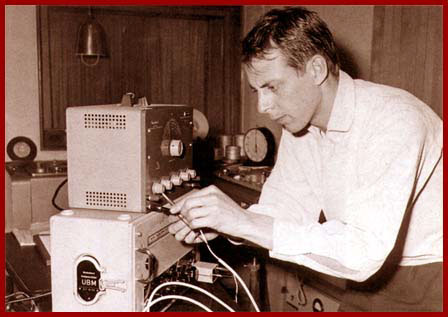
Sometime in 1954, the German composer Karlheinz Stockhausen began writing a Catholic Mass for electronic sounds--he intended to debut the piece in the Cologne Cathedral, until the Church ruled against allowing loudspeakers to be placed there.

Stockhausen intended to fuse the human voice with computer-made sounds, something that had never been attempted on so broad a scale before. Working in West German Radio's Studio for Electronic Music, Stockhausen began by recording a 12-year old boy singing verses from an apocyrphal version of the Book of Daniel--the "song of the youths" the title refers to. These are the praises to God sung by the Hebrew youth hurled into the fiery furnace by King Nebuchadnezzar, and who emerged unscathed.

Some of the verses sung are:

Preiset den Herrn, aller Regen und Tau--
Preiset den Herrn, alle Winde.
Preiset den Herrn, Feuer und Sommersglut--
preiset den Herrn, Kalte und Starrer Winter.


(Praise to God, all rain and dew
Praise to God, all wind.
Praise to God, fire and summer's heat
Praise to God, cold and frigid winter)

Stockhausen manipulated the multiple recordings he made of the boy singing, using "Preiset den Herrn" as a sort of centerpiece, the reoccuring motif the piece is built around. Then, using a frequency generator, he created sine waves to match the vowel sounds from the boy's recording, and electronic white noise to match the consonant sounds.

And at last, Stockhausen mixed everything together--so that the shards of the boy's voice are made equivalent to the dabs of electronic squalls. While very much intended to be a devout work of praise to God, the result can seem quite horrifying and dehumanizing, the sound of the human being at prayer subsumed into a din of computer generated nightmares. But there are pieces of amazing beauty as well.

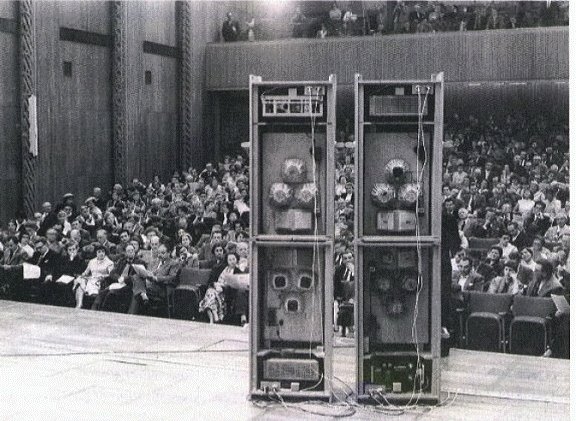
A caveat: listening to this compressed MP3 to get a sense of what Stockhausen did is like squinting at a low-bit-rate JPG file of a Van Gogh painting to see VG's brush strokes. For one thing, Stockhausen recorded the piece in five channels, and created an early version of "surround sound" to play it--five speakers placed around the performance space, so that noises would appear to be bouncing around, veering from behind you and reeling off the far distance.

It was premiered on May 30, 1956, in Cologne (photo shown above). Find on Stockhausen 3: Etude. Stockhausen is still composing today, his reputation tarred by some stupid remarks he made after the 9/11 attacks.

So enjoy. If you haven't hear "Gesang" before, you might hate it intensely, you might love it. Post your reactions if so inclined.


And then we have Clarence "Frogman" Henry. Consider it a rock & roll riposte to Karlheinz--Henry says he can sing like a girl (allegedly an imitation of Shirley Goodman), and sing like a frog, all without the aid of any electronic manipulation. And so he does.

Clarence Henry was born in Algiers, Louisiana, in 1937, and played with the Bobby Mitchell band in New Orleans. Paul Gayten, one of the great New Orleans arrangers and composers, discovered Henry and convinced him to go solo, co-writing "Ain't Got No Home" with him. Mr. Henry's home was damaged during Hurricane Katrina, but thankfully he came out all right.

"Ain't Got No Home" was released in October 1956 as Argo 5259. Find here.

Apropros of nothing dept.: For some reason, I've become the number one source, according to Google Images, of a photograph of the writer Mary McCarthy (it's not even on the site--I linked to it in one of the "drinks" posts). That's fine, but what bewilders me is that I now get about three dozen or more people a day hitting this site in search of the picture. Who knew there was such a demand for Mary McCarthy photos? I mean, it's a nice picture--she's very pretty--but, still, it's all a bit odd.

Thursday, April 20, 2006

1956


Bobby Helms, Fraulein.


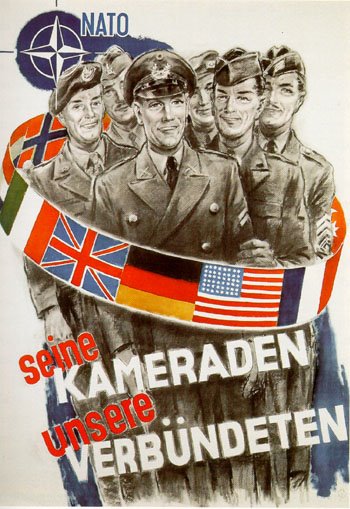
While "Fraulein" was written by Texas composer Lawton Williams about a girl he once knew in a German neighborhood of Houston, the song's success in the late '50s via Bobby Helms' interpretation likely was owed to a good deal of nostalgia by former GIs, dozing away in suburban marriages, remembering their time in Germany during the war and its aftermath. That said, Germany in the late '40s doesn't seem like the most romantic of places, to put it mildly.

The song became a monster hit--as of a few years ago, Helms still held the all-time record for weeks on the Billboard charts with a single song: 52 consecutive weeks, or one solid year of "Fraulein."

Helms (best known for "Jingle Bell Rock") catered to Pacific Theater GIs with his next single, "Geisha Girl," inspiring an answer record from Jimmie Skinner called "I Found My Girl in the Good Ole USA."

Recorded in Nashville on November 15, 1956, with Tommy Jackson (fiddle), Farris Coursey (drums), the awesome Hank Garland on guitar, Owen Bradley (p) and possibly Bob Foster on steel. Released in early '57 as Decca 30194. Find here.

More on GIs and Frauleins.

Wednesday, April 19, 2006

1956


Nat King Cole, I Know That You Know.

The reputation of Nat Cole, over the past decade or so, has been restored a good bit, if not enough. Gradually and in some cases grudgingly, Cole's prowess as a jazz musician has been acknowledged, and he is no longer simply known as the purveyor of 'easy listening' classics like "Unforgettable" and "Mona Lisa."

Cole's roots were in swing and jazz--his great 10-minute version of "Body and Soul" with Les Paul during the first Jazz at the Philharmonic concert in 1944 ought to have shut up detractors in the first place--and in 1956, Cole returned to a small group setting for the sessions of what became his finest record of the decade, After Midnight.

"I Know That You Know" demonstrates Cole's effortless phrasing, the way he remains utterly calm and suave even at a breakneck tempo. Cole takes on Vincent Youmans' melody like it's a steeplechase, and wraps up the first verse completely unwinded. Violinist Stuff Smith plays Grappelli to Cole's Reinhardt--each gets a 16-bar chorus, and then the two spar off in a marvelous series of exchanges in which one sets the bar and the other vaults it.

Recorded on September 24, 1956, with Cole, Smith, John Collins (g), Charlie Harris (b) and Lee Young, Lester's brother, on drums. Find on After Midnight.

Earlier in 1956, Cole had been attacked during a concert at the Birmingham, Ala., Municipal Auditorium. More here. In short, a group of homicidal white supremacist idiots, already raging at the evils of rock & roll and Brown v. Board of Education, decided to kidnap Cole while he performed.

Gary Sprayberry: "Two other men, Adams and E. L. Vinson...had already surged over the footlights by the time Higginbotham reached the stage. Adams hit [Nat] Cole with a "flying tackle," and the singer fell backward onto his piano bench, snapping it into two jagged pieces. Adams then snatched up one of Cole's legs and attempted to drag him off the stage. just before he reached the edge, officers swarmed in from the wings, halting both attackers with a hail of fists and nightsticks. They handcuffed all three assailants and hustled them outside. Almost as soon as the melee had broken out, it was over.

For the audience, who sat in stunned silence throughout the ordeal, the whole affair seemed like an absurd comedy, purposely staged and chaotically performed by Cole and the Birmingham police
."

Sadly, Cole's troubles didn't end when he flew out of Birmingham. Asked at O'Hare Airport whether he would continue to perform before segregated audiences, Cole said he would, noting that since the Supreme Court was having trouble integrating schools, how could he alone integrate audiences? The remark infuriated Cole's African-American fans, some of whom boycotted his records, and even Thurgood Marshall said, "All Cole needs to complete his role as an Uncle Tom is a banjo."

Tuesday, April 18, 2006

1956


don't mess with an Okie rock & roll goddess

Glenn Barber, Shadow My Baby.
Wanda Jackson, Hot Dog! That Made Him Mad.


Paranoia strikes: Glenn Barber is going to hire a private detective to follow his girl around. She's running wild, wearing new red shoes, spending his money on who knows what--even some of her awful family have shown up wearing new clothes. He can't even trust his friend, who seems too familiar with his house and has Barber's dog eating out of his hand. He's one step away from madness.

And Wanda Jackson's reply: go stew in it, creep!

Barber, born in 1935, started as a country musician until he began pushing up the beat and playing rougher and harder--he was one of the legion of unknown rockers who built the music's foundation. "Ice Water," from '55, was a great example of hillbilly bop, but "Shadow My Baby," released the next summer, is something else--echo-drenched, frantic, bizarre, in which the guitar and saxophone blur to become one knife of sound.

"Shadow" is a gift from the Reverend Frost, so tell him thanks next time you visit. Released in the summer of '56 as Starday 249 b/w "Feeling No Pain." As far as I can tell, the only place to get "Shadow My Baby" on CD is on a compilation called Rockabilly Shakeout, which you can find as a UK import.

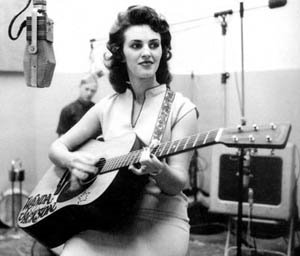
Wanda Jackson, of course, was the queen of rock & roll in the 1950s. Like Barber, she started out pure country--born in Oklahoma in 1937, she was performing duets with Hank Thompson by the early 1950s. But when she toured with Elvis in 1955 and dated him, he convinced her that rock & roll was the future. "Hot Dog!", a rocking primer on how to drive your irritating boyfriend crazy with jealousy, was one of her first tracks in this vein, and one of her finest--recorded on September 20, 1956, it was released as Capitol 3575 in November, and also wound up on the great album Rockin' With Wanda--find it on Vintage Collections. Soon to come would be the almighty "Fujiyama Mama", in which Wanda likens herself to the A-bomb.

Wanda Jackson is burning up the stage today--check out her tour dates and CDs.

Thursday, April 13, 2006

1955


the ultimate answer to immigration

Sonny Rollins, There's No Business Like Show Business.
Nappy Brown, Don't Be Angry.
Dean Martin, Memories Are Made of This.
Elmer Bernstein, Frankie Machine.
Smiley Lewis, I Hear You Knocking.
Sonny Terry and Brownie McGhee, Ride and Roll.
The Turbans, When You Dance.
The Blues Rockers, Calling All Cows.
Marty Robbins, Tennessee Toddy.
The Robins, Smokey Joe's Cafe.
Jon Hendricks and Dave Lambert, Cloudburst.
Sonny Boy Williamson, From the Bottom.


A cold spring:
The violet was flawed on the lawn.
For two weeks or more the trees hesitated;
the little leaves waited,
carefully indicating their characteristics.
Finally a grave green dust
settled over your big and aimless hills...


Elizabeth Bishop, A Cold Spring, 1955.

Shall we wind out 1955? Sit down, take a minute. There.

"No Business Like Show Business": After a tiny feint by Ray Bryant on piano and fanfare on drums by Max Roach, Sonny Rollins is off like a shot, bobbing through Irving Berlin's melodic spiral. In Rollins' first solo chorus, he is supported only by George Morrow's bass; in his second, he's pure swagger, bursting with energy and attitude. Bryant provides a fleet dance on the piano, and Roach gives one of the more melodic drum solos ever recorded. The whole track is a thing of joy--taped in Hackensack, NJ, on December 2, 1955. On Worktime.

In "Don't Be Angry," Nappy Brown elongates the first word of the verse, turning the humble "so" into a bit of glossolalia, fattening it into eight or more syllables and twining around it a knotty string of "ell" sounds. (The legend is that Savoy Records head Herman Lubinsky thought Brown was singing in Yiddish.) Brown's competing with Sam "The Man" Taylor's meaty tenor sax solo, and it's hard to pick who wins. Recorded on February 1, 1955 and released as Savoy 1155. On Don't Be Angry!

Dean Martin's "Memories Are Made of This" is Hollywood folk-pop, with Dean supported by the Easy Riders. For a Capitol Records A-list pop recording from 1955, this is a surprisingly spare production--just guitar providing a trellis for the singers. And Dean's vocal presages two decades of Elvis Presley ballads. Recorded on October 28, 1955 and released a month later as Capitol 3295 (it was a #1 hit by year's end). On Capitol Collectors Series.

Elmer Bernstein's "Frankie Machine" is from the soundtrack to The Man With the Golden Arm. It's the sort of brassy, frenetic piece that would become standard-issue for most police and 'social problems' dramas for the next 15 years. There's a lot to enjoy, from Shelly Manne's drumming (a hybrid of cool jazz and marching band) to Shorty Rogers' solo on the flugelhorn (!) to the way the brass section sizzles to a boil. Recorded in LA on December 15, 1955; find here.


The Brooklyn Dodgers finally won it all. And two years later, the team got moved to Los Angeles, a crime still unatoned for.

"I Hear You Knocking": What else can you say? This is rock and roll; this is the majesty of New Orleans. Dave Bartholomew, Huey "Piano" Smith, Smiley Lewis--they're all there in the groove. Recorded in March (or May), 1955, and released in July as Imperial 5356; find here.

"Gimme your ticket--lonnnnng as my right arm." "Ride and Roll," a forgotten but driving electric blues, was created by an all-star team: Sonny Terry on harmonica and vocal, Stick McGhee and Brownie McGhee on guitars, and Milt Hinton on bass. Recorded on November 7, 1955, and released as Groove 0135. On That's All Right.

The Turbans were from Philadelphia, and their fleeting taste of fortune is the early rock & roll era (heck, any pop era) in miniature. Four kids--Al Banks (lead), Matthew Platt, Chet Jones and Charles Williams--get an act together (and yes, they wore turbans sometimes); they find a manager; the manager contacts a local R&B label; they cut a hot record that gets airplay, at first locally, then nationally; the group tours with top names; the next single keeps the momentum going, but the third stiffs; the group loses steam, further singles flop, their label drops them; a stay on another label produces little of merit; the group breaks up. But they left a shard of immortality behind--"When You Dance" smokes. Recorded in summer '55 and released as Herald 458. Find here.

"Calling All Cows," a Chicago blues novelty scratched together in Nashville, was by the Blues Rockers--Earley Dranne (vox, guitar), PT Hayes (harmonica), Lazy Bill Lucas (p). Issued as Excello 2062. You can never have enough tracks with guys mooing as background vocals. Find on the now out of print Excello Story Vol. 1.

"Tennessee Toddy," in which Marty Robbins goes catting around with a nymphet and gets a crack on the head, is on Essential Marty Robbins.

The voice of America (or at least, how it used to sound): goofy, clever, a bit ridiculous, hyperactive, irreverent--it's all in Leiber and Stoller's "Smokey Joe's Cafe." It reminds me of when Nabokov emigrated to the U.S. during WWII, having barely escaped Nazi Germany and Vichy France, and the first thing that occurred when he arrived was that a pair of customs officers opened his suitcase, found some boxing gloves and began sparring with each other.

"Smokey Joe's" was one of the finest records by the fantastic Robins, who broke up soon after its release--from their embers rose the far more successful (commercially, not artistically) Coasters. First released in August 1955 as Spark 122; then almost immediately after as Atco 6059, when Atlantic bought the rights and snagged Leiber and Stoller in the process. On Doo Wop Classics.


Helen and Aphrodite, in their 1955 incarnations

Jon Hendricks, before he joined Annie Ross and Dave Lambert in 1958 as a formal trio, had been experimenting with vocalizing jazz performances, fitting lyrics over what been improvised instrumental solos. In 1955, Hendricks teamed up with Lambert for the first time to convert Benny Harris and Leroy Kirkland's "Cloudburst" (using Sam "The Man" Taylor's recording as template) into a run of vocal acrobatics, with the "shave and a haircut--two bits" motif as a hook. The track features Hendricks, Lambert and four other singers (Marian Workman, Jerry Duane, Butch Birdsall and some other guy, whose name is apparently lost to history).

Recorded on May 1 (or 12), 1955 and released as Decca 29572; it can be found on Sing a Song of Basie.

The core of Sonny Boy Williamson's "From the Bottom" is the fantastic beat, which sounds like someone is thumping a metal water can. B.B. King provides a hot guitar solo and Williamson's minimalist lyrics are a fun puzzle as well. (Sonny's girl is good-looking enough to land her a role in Hollywood, and he's going with her to see what happens. Or maybe it's just about how much Sonny likes his woman's ass.) Actually recorded on November 12, 1954, but let's let it through. Issued as Trumpet 228, the last Trumpet single ever released, and found on Cool Cool Blues.

Films of '55

Another holy monster of a year.

The Night of the Hunter. In which you experience the worst childhood nightmare imaginable--you are orphaned, a horrific step-parent appears to take you away, your preacher is an emissary of darkness.
Sommarnattens leende (Smiles of a Summer Night). Bergman's A Midsummer Night's Dream.
The Ladykillers. Genius performances by Alec Guinness, Peter Sellers and Herbert Lom, but the soul of the movie is Katie Johnson, playing Mrs. Wilberforce, the last Victorian lady. And yes, the Tom Hanks remake is a piece of crap.
The Night My Number Came Up. Someone put this out on DVD: I'm begging you. Hell, I'd take a VHS copy.
Rebel Without a Cause. While rock & roll precedes this film by years, you could make the case that "Rebel" somehow stamped rock music in its own image, despite not having a note of it on the soundtrack. The whole thing is a frenzied teenage aria; its actors seem on the brink of going into hysterics.
Kiss Me Deadly. Mike Hammer: "You were out with some guy who thought "no" was a three-letter word. I should have thrown you off that cliff back there. I might still do it."
Pather Panchali.
The Phenix City Story.
Nuit et Brouillard (Night and Fog). Ten years after the camps were closed, the world had barely begun to admit what had happened there. After this film, there were no more excuses.
This Island Earth.
Ordet.
Muerte de un Ciclista (Death of a Cyclist).
Count Three and Pray.
Lola Montès/French Cancan. Two late spectacles by Ophuls and Renoir, in which the masters return, after a long journey, to the theatres and circuses of their youth.

Happy weekend, happy Easter, happy Passover, etc.

Tuesday, April 11, 2006

1955


The Four Deuces, WPLJ.
The Meadowlarks, Heaven and Paradise.
The Cadillacs, Speedo.


The legend is that 15,000 doo-wop groups were formed in the 1950s: here are the testaments of three.

The Four Deuces' "WPLJ" stands for "white port [and] lemon juice," a rather volatile cocktail (see below) that was a band favorite. The song may have been initially designed as a jingle for a local wine merchant--no one really knows. Formed in Salinas, California, by a quartet of army buddies, the Deuces put out three singles before splitting up in the late '50s.

A decade later, around the time Frank Zappa and Lowell George covered the song, the New York City radio station WABC changed its call letters to WPLJ (once home of Vin Scelsa, whose "Idiot's Delight" program in the '90s was one of my primary inspirations for this starting this site). Ironically, PLJ's current ossified "hot adult contemporary" format means that the station will never play its namesake. But we will, by God.

"WPLJ" was released as Music City 790 in 1955 and became a regional hit by early '56. It's rarely been put out on CD, though it appears to be on a compliation called "Doo Wop Party" found here.

More on drinking WPLJ, from the jazz musician Roy Porter's autobiography, There and Back, 1991:

"At that time we were drinking Molotov Cocktails, which is white port wine mixed with lemon juice. Man, we would get four or five quarts of white port, buy some inhalers [filled with benzedrine], break them open, put the strips in each bottle of wine, put the wine next to a heater or heat, and let it sit and dissolve for a few days. When you drink that shit, man it will blow your mind, but we would be feeling mellow being loaded for days without any ZZZ's.
"

"But my real name is Mr. Earl." The legendary "Speedo" was released as Josie 785 in December 1955. Find on the utterly essential Best of Doo-Wop Uptempo.

The Meadowlarks were a Los Angeles group, consisting of Don Julian on lead, Randolph Jones, Earl Jones, Ron Barrett, and Bill Pruitt. Their masterpiece, "Heaven and Paradise", was released as Dootone 359 in March 1955--it was by far their biggest hit (although mainly on the coasts). The group would persevere in some form or other for another decade. In the '70s, Don Julian wound up scoring blacksploitation films like Shorty the Pimp. Find "Heaven" on Golden Classics.

Thursday, April 06, 2006

1955


Ahmad Jamal, Love for Sale.
Ahmad Jamal, Poinciana.
Herbie Nichols, The Third World.
Herbie Nichols, Cro-Magnon Nights.

The history of jazz piano, a special love of "Locust St", can sometimes get too condensed. Usually, after we meet the founding fathers, from James P. Johnson to Bud Powell, there's then a broad-jump into the 1960s, to Herbie Hancock and Chick Corea. Left in the gap are a set of pianists who, while perhaps not the most revolutionary of players, still deserve far more consideration.

Here are two: the underrated Ahmad Jamal and the near-unknown Herbie Nichols.

Jamal, born in Pittsburgh in 1930, began playing in George Hudson's orchestra and built up a repuutation in Chicago. In 1952, he came to New York, playing at the Embers club (where, at one point, fed up with crowd chatter, he stomped off the stage in the middle of a set and went back to Chicago). He was championed first by John Hammond, then by Miles Davis, who was enthralled with Jamal's playing (Jamal's versions of "Autumn Leaves" and "It Never Entered My Mind" provided Davis with a roadmap for his own takes a few years later).

By 1955, Jamal had assembled an excellent trio: Jamal provided spare, clean piano (Nat Hentoff, like a number of critics, thought he was too clean, once calling Jamal a "cocktail pianist" in front of an indignant Miles Davis); Ray Crawford, on guitar, often provided the rhythms by rapping the strings (for much of "Love for Sale," his guitar sounds like a bongo); Israel Crosby, on bass, built a stage for them both to perform on.

Here are two tracks from an October 25, 1955 session for Epic Records:

Cole Porter's "Love For Sale" has been covered by seemingly every jazz musician of note; it's up there with "Body and Soul" in terms of jazz warhorses. But Jamal's interpretation, infused with a bit of Dizzy Gillespie's "Manteca," is a fresh, excellent performance, during the course of which Jamal seems to take the keyboard to its utmost limits--lingering at the edges, diving across the keys. After Crawford's elegant solo, Jamal finds a note and then just massages it, repeating it close to two dozen times.

"Poinciana" would become Jamal's best-known track in a hit version he recorded in 1958. This take, however, is Jamal's first attempt, and is almost more of a solo vehicle for Crawford.

Find both on Legendary OKEH and Epic Recordings. For more on Jamal,
Nick Francis
had a nice post a while back. And Mr. Jamal himself is still going strong.

For much of his life, Herbie Nichols, a generation older than Jamal, lingered in obscurity, doing time in Dixieland revival bands to pay the bills (a galling fate for a player whose stated influences included Stravinsky, Shostakovich, Tatum and Bartok, and who once said "jazz has come a long way since 'the stomp'"). He hardly recorded, and a great number of his compositions are lost.

Nichols, born in 1919, began playing in the late 1930s and befriended a number of musicians, including Thelonious Monk, Mary Lou Williams and J.J. Johnson. He was considered a bit of an oddity, as he would later acknowledge in an interview--"In those days I must have looked kind of like a professor, with a starched white shirt. I used to talk about poetry almost as much as I did about music."

Throughout the late '40s and early '50s, Nichols failed to get recording contracts, and had a hard time organizing groups and landing gigs. When he did get on stage, it was usually as a sideman for Dixieland bands, blues sessions and even rock & roll shows. At last, in 1955, he got a deal with Blue Note, for which he recorded his only sessions as a leader.

While his sound is indebted in part to Monk, Nichols' playing is dense, gnomic and utterly free of any blues or swing cliches. At his best, as in "Third World" or "Cro-Magnon Nights", he created a form of cool, rarefied jazz that has few antecedents. Nichols died in 1963 of tuberculosis, and is remembered best for his tune "Lady Sings the Blues," which Billie Holiday adopted as her own in her final years.

Recorded on May 6, 1955, with Art Blakey on drums and Al McKibbon (b). On Complete Studio Master Takes.

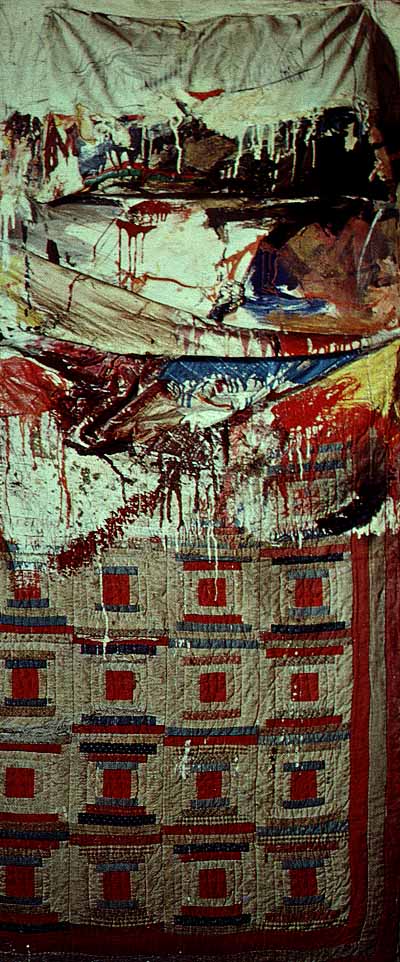
Top: Robert Rauschenberg's Bed.

Tuesday, April 04, 2006

1955


Howard Hughes' Waterloo

Muddy Waters, Mannish Boy.
Tennessee Ernie Ford, Sixteen Tons.
Etta James, W-O-M-A-N.
Jeri Southern, An Occasional Man.


What makes a man? What makes a woman? How much of what we perceive of manhood, for example, is mere communal delusion? Impossible questions answered in pop songs.

"Mannish Boy" and "Sixteen Tons" define manhood in terms of getting some respect. Muddy Waters does so with swagger and confidence (and he's got some witnesses, in the form of the guys in the studio who shriek with approval every time Muddy notes that he's a man), while Tennessee Ernie Ford offers a form of cool braggadocio that seems to border on the psychotic, as witnessed in the badass lines:

If you see me coming
better step aside
A lotta men didn't
A lotta men died

But when you grow weary of male bluster, enjoy Etta James' sexy and laid-back response. She's seen and heard it all before, and has had her fill of the jive talk and boasts from men with empty pockets. When you come down off the roost, come see about me.

Jeri Southern is tired of the game as well: "An Occasional Man" is her Pacific fantasy, where she resides in tropical bliss and gets her pick of the crop in terms of the local men (who seem to get the boot as soon as she's done with them).

"Mannish Boy," recorded on May 24, 1955, with Willie Dixon on bass and possibly Little Walter on harmonica, is essentially the same tune as Bo Diddley's "I'm a Man," recorded two months earlier (the legend goes that Muddy walked in on Diddley auditioning the song to Leonard Chess and wanted to take it, figuring this Diddley guy was a nobody; when that wasn't an option, Muddy basically rewrote it). A decade later, both tracks would inspire a generation of spotty British and American youth, who took the songs' undeniable claims to manhood (in a country like the United States in 1955, a Mississippi-born African-American man saying "I'm a man" was a revolutionary statement) and transformed them into a way to dignify a teenage boy's lust--the Yardbirds' "I'm a Man" being the most notable result. In 1976, Waters performed "Mannish Boy" at the Band's "Last Waltz" concert, and Waters is the centerpiece of the Scorsese film that came out two years later--smiling, virile, demanding the camera's complete attention--making the coked-out rock stars supporting him look a bit ridiculous. On Anthology.

Merle Travis' "Sixteen Tons" was recorded by Ford in Hollywood on September 20, 1955, and released as Capitol 3262. Part novelty (a song that sounded like a Depression-era union anthem that hit #1 in the waning days of McCarthyism), part rock & roll experiment on the part of Ford and Capitol, it was a colossal hit, selling a million copies in two months. On Greatest Hits (where Tennessee looks like Walt Disney on the cover).

"W-O-M-A-N" was one of Etta James' first singles, consolidating the presence she had established with "Roll with Me Henry" and "Good Rockin' Daddy"; Recorded in October 1955 and released a month or so later as Modern 972. On R&B Dynamite.

Jeri Southern, reclusive, beautiful and brilliant, is the most underrated female vocalist of the '50s. Hugh Martin and Ralph Blane's "An Occasional Man" was recorded on July 27, 1955, and released as Decca 9-29647. On The Very Thought of You.

Thursday, March 30, 2006

1955


Little Richard, Tutti Frutti.
Bobby Charles, See You Later Alligator.
Bo Diddley, Pretty Thing.
The Drifters, What'cha Gonna Do.
Little Willie John, All Around the World.
Chuck Berry, Thirty Days.


Oh! pleasant exercise of hope and joy!
For mighty were the auxiliars which then stood
Upon our side, we who were strong in love!
Bliss was it in that dawn to be alive,
But to be young was very heaven!--Oh! times,
In which the meagre, stale, forbidding ways
Of custom, law, and statute, took at once
The attraction of a country in romance!


Wordsworth, The Prelude.

Gonna reel, gonna roll, gonna dance, drink, have a ball,
What you gonna do--
About nine o'clock?
Have you heard the news?
Yeah! We're gonna rock.


The Drifters, "What'cha Gonna Do."

Rock & roll avalanche!

The legendary "Tutti Frutti"--what more can be said about it? One of the quandaries of rock & roll is that right upon its birth it achieved perfection, and in a way, had nowhere else to go. You can get louder, heavier, more vulgar, nastier, dumber, more ridiculous, more complex, more "meaningful" than "Tutti Frutti", but "Tutti Frutti" resists all attempts to better it--it can't be mastered. You could say the history of the past 50 years in rock music is that of generations of musicians trying and usually failing to do so.

Released in October 1955 as Specialty 561. On 18 Greatest Hits.

Bobby Charles' "See You Later Alligator" and Bo Diddley's "Pretty Thing" are altars to the all-mighty beat--in Charles' case, it's an irresistable New Orleans shuffle (courtesy of Paul Gayten); for Bo, it's a hypnotic dance carried by maracas, drums, harmonica and scratchy guitar (love the long fade-out, in which the beat slowly ebbs away).

"Later Alligator" (as the first pressings called it) was recorded in October 1955 and released a month later as Chess 1609; Bill Haley quickly covered it. Diddley's "Pretty Thing" was recorded on July 14, 2955 and released in November as Checker 827. Find both here.

"What'cha Gonna Do" is the apex of the Clyde McPhatter-era Drifters for me--it swings, it rocks, it's as sleek as a Porsche. Released as Atlantic 1055 in February 1955; find on Rockin' and Driftin'.

For teenagers just discovering this music, rock & roll songs seemed to communicate in secret alphabets, with a collection of lyrics that consisted of non sequiturs, shibboleths and joyful nonsense. Case in point, the chorus of "All Around the World"--"Grits ain't groceries/eggs ain't poultries/and Mona Lisa was a man." Little Willie John's first major hit, "All Around the World" (with Champion Jack Dupree on piano and Willis Jackson on a killer tenor sax break) was recorded on June 27, 1955 in New York and released as King 4818. Find here.

Chuck Berry's "Maybellene" was the single that broke him in the summer of '55, but I like the follow-up, "Thirty Days", slightly more. Even more than "Maybellene," "Thirty Days" shows its country roots--it's almost a lost Bob Wills track. Rich in future predictions, like a sonic Planchette, it provided lyrical cues for the Rolling Stones and Eddie Cochran and who knows else. Chuck offers a wild, spidery guitar solo and whoever is on drums, Jasper Thomas or Ebby Hardy, pounds the holy hell out of them.

Recorded in September 1955, with Willie Dixon on bass, Johnnie Johnson (p) and Jerome Green (of "Bring it to Jerome" fame) on maracas; released as Chess 1610, possibly later the same month. Chess had a quick turnaround time. On Gold (which appears to be the Chuck Berry Anthology under a new name).

Tuesday, March 28, 2006

1955


Billy Boy Arnold, I Wish You Would.
Big Joe Turner, The Chicken and the Hawk.


"Mentally, I found her to be a disgustingly conventional little girl. Sweet hot jazz, square dancing, gooey fudge sundaes...these were the obvious items in her list of beloved things. The Lord knows how many nickels I fed to the gorgeous music boxes that came with every meal we had! I still hear the nasal voices of those invisibles serenading her, people with names like Sammy and Jo and Eddy and Tony and Peggy and Guy and Patty and Rex, and sentimental song hits, all of them as similar to my ear as her various candies were to my palette."

Vladimir Nabokov, Lolita, published 1955.

Two for Humbert Humbert and poor Dolores Haze:

Billy Boy Arnold started out playing blues on the streets of Chicago with his friends Ellis McDaniel and Jody Williams, and all three wound up recording for local label Chess, performing the song "Bo Diddley", from which McDaniel got his stage name. Arnold never got along well with Chess, so he left for rival label Vee-Jay--Vee-Jay naturally was hot for more "Bo Diddley"-style songs, so Arnold went home and wrote "I Wish You Would."

"So then I'd made me get a label for the rest of my life with a Bo Diddley type of song. Which I had no intention of ever doing. I was a straight blues guy. I didn't want to be capitalizing on no Bo Diddley type of thing. But once you do something, you're stuck."

Recorded on May 5, 1955 with Jody Reynolds on guitar, Henry Gray (p), Milton Rector on electric bass and Earl Phillips (d); it was released as Vee-Jay 146 a month later. Find here.

And Big Joe Turner gets away with yet another lyric that ought to have had parents rioting in the streets. Recorded on November 3, 1955, with Connie Kay on drums (a founding member of the Modern Jazz Quartet, he would later play on Van Morrison's Astral Weeks). Released at year's end as Atlantic 1080. Find here.

To learn more of the strange publishing history of Nabokov's Lolita (first edition shown above, a pair of verdigris-colored paperbacks published in France in September '55--the book would not be allowed in the U.S. for three more years), look here. Also, Nabokov's angry rebuttals to claims made by the French publisher, Maurice Girodias ("He wanted Lolita not only because it was well written but because 'he thought that it might lead to a change in social attitudes toward the kind of love described in it.' It was a pious although obviously ridiculous thought but high-minded platitudes are often mouthed by enthusiastic businessmen and nobody bothers to disenchant them.")

Monday, March 27, 2006

1955


The Jazz Messengers, Prince Albert.

Jazz is supposed to be pure democracy in music--at least, that's how it's described whenever Wynton Marsalis gets in front of a camera--but it rarely works out that way. There are arrangements to write, and songwriting credits to haggle over, and the hapless task of organizing musicians, who are no strangers to ego and sloth, generally requires someone to crack the whip. No one did the latter better than Miles Davis, who, even in 1949, was known as the guy who called the shots and signed the checks--but you would never think of a Davis group as a pure "cooperative" either.

The Jazz Messengers, Art Blakey's dream of a jazz cooperative, evolved into a similar type of vehicle by the late 1950s--a band with a rotating cast dominated by the genial Blakey as bandleader. But in the Messengers' first years, the band was very much a contest of equals--Horace Silver on piano, the trumpeter Kenny Dorham, Hank Mobley on tenor sax, Doug Watkins on bass and Blakey on drums.

So hear democracy in action--Dorham's "Prince Albert" is his variation on the chords of Jerome Kern's "All the Things You Are" (known by music students as "All the Changes There Are"). Dorham begins the solos, all air and confidence (he even throws in a bar or two of "Camptown Races"); Mobley follows with a mixture of power and finesse. Blakey adjudicates throughout, challenging the players by shaking up the time.

Recorded on November 23, 1955, at the Cafe Bohemia in New York, a short-lived but legendary jazz club in Greenwich Village. Find "Prince Albert" here. You can visit the site of the former Cafe Bohemia at 15 Barrow St., in New York, but be warned--it has been reincarnated as the Barrow Street Alehouse, a bar often frequented by drunk, unpleasant college kids.

Buck Owens 1929-2006


It's been a tough year already, eh? We were going to meet Buck in a couple months as part of this survey, but sadly, it's time for a brief tribute to one of country's music's last legends.

Buck Owens, Waitin' in Your Welfare Line.
Buck Owens, It Takes People Like You (To Make People Like Me).


The first, from 1966, has one of Buck's funniest lyrics, though there's a tenderness to his voice that takes the song beyond its limits. The second, from 1967, is a sweet, straightforward thank-you note to his fans.

More at Big Rock and There's Always Someone Cooler.

Tuesday, March 21, 2006

1955


Peggy Lee, I Don't Want to Play in Your Yard.
Peggy Lee, A Brown Bird Singing.
Frank Sinatra, In the Wee Small Hours of the Morning.
Frank Sinatra, I'll Be Around.


How distant the war years had become: the gulf between the hot, sparkling summer of 1955 and the grim one of 1942, the summer of Guadalcanal and Stalingrad, must have seemed colossal, as though the entire world had undergone such a sea change that you were surprised, upon finding a wartime newspaper, that the people alive then had spoken the same language as you. Figures from that time who still held the stage--a Churchill or DeGaulle--seemed as fantastics, waxworks breathed into frail life.

In 1955, Frank Sinatra turned 40, and Peggy Lee was 35. Could they even recall those days--the long nights on the bandstand (Sinatra with Tommy Dorsey, Lee with Benny Goodman) waiting for their cues? The overcrowded, stifling USO dances; the smell of Vitalis and Lucky Strikes; the girls clinging to boyfriends or husbands about to be shipped off to die in Anzio or Normandy; the buses hauling the musicians across the night, to Dubuque and Cheyenne and Sioux City; grabbing meals at the automat, washing clothes in a hotel sink. Sinatra causing girls to scream in waves when he sang; Lee terrified in the spotlight, feeling like a hayseed from North Dakota, being forced to wear the same gowns as Helen Forrest, the singer she was replacing.

But the world had turned, and Sinatra, in particular, had had a hard time of it. By the late '40s, his singles were flopping; it seemed he couldn't find good material if he paid for it, and once on stage at the Copacabana his voice simply died. He grew a moustache that made him look like a car salesman and hosted an ill-fated television show. Most of all, his romance with Ava Gardner, likely the love of his life, withered and died, all in front of the eager public, who voraciously followed the marriage's collapse via gossip columns and magazines.

Lee tumbled as well. She had married her guitarist, David Barbour, and for a while carried off a life tailored for the celebrity press--the happy Lee/Barbour family, raising a daughter, composing songs, vacationing in Mexico. But Barbour was an alcoholic who at one point allegedly sold off the rights to one of their compositions, "Manana", for two tickets to the Rose Bowl.


Lee recovered first. She divorced Barbour in '51, and, with a child to support, began to reinvent herself for the new decade. She signed with Decca after Capitol had rejected her and Gordon Jenkins' interpretation of "Lover," which turned the Rodgers and Hart number into a wild, almost surreal whirlwind of sound. At Decca, she crafted far more sultry, jazz-infused and intelligent music than she had during her early Capitol years--songs like "Black Coffee", "My Heart Belongs to Daddy", "There's a Small Hotel."

Sinatra caught some breaks too--he landed the role he craved in '53's From Here to Eternity (a process referred to not-so-obliquely in The Godfather, though I don't think Buddy Adler got a horse's head in his bed), which made him legitimate again, and helped him land a new contract with Capitol.

And Sinatra was one of the first of the swing-era musicians to grasp the realities of the new world--people were living in the suburbs, they had kids, and the domestic sphere had begun to encompass all. Why haul the family to the movies when you had TV? Why go downtown, to increasingly shady nightclubs and decaying parking lots, when you could just go to the store and buy a new 12" LP? So Sinatra and his arrangers began crafting concept records--song suites meant to serve as a sonic backdrop to home life, to a dinner party, for a drunken, lonely evening.

In the Wee Small Hours was Sinatra's first full-length LP to follow this formula, and the mood conveyed was melancholy, loss and regret. Sinatra created the persona--one depicted on the LP's cover: a stoic, wistful Frank, standing alone in a blue mist, with just a cigarette for company. It's a musical take on film noir, with Sinatra playing Philip Marlowe, and Nelson Riddle's arrangements for the LP follow the same cue: many of them could have easily served as scores for Force of Evil or The Postman Always Rings Twice (the sudden swings of the orchestra in "Last Night When We Were Young," the ominous introduction to "Deep in a Dream").

Here are two tracks from the album--the classic title song, written by David Mann and Bob Hilliard (one of the few newly-composed songs on the LP), was recorded on February 17, 1955, while Alec Wilder's "I'll Be Around", recorded on Feb. 8, has one of Sinatra's most compelling vocals--completely humble, supplicating his estranged lover with words infused with desperate hope.

Wee Small Hours is one of those essential records that seemingly everyone recommends, but really, it's that good.


Lee followed a similar path (Black Coffee is another early "concept" LP, and Lee found success in films as well) but she took an interesting turn in 1955. She had found a book of Chinese poems that captivated her, and intrigued, she set about adapting poems like Tu Fu's "Going Rowing" and Li Po's "The Fisherman" to song, using just harpsichord and harp as accompaniment.

Unlike Wee Small Hours, Sea Shells reached no one, because Decca put the LP on ice, finding the whole concept indulgent and bizarre (this seems in retrospect a bone-headed move, as Decca was ignoring the growing popularity of "Far East" sounds, like Martin Denny's records--you'd have thought South Pacific's massive success would have rung a bell somewhere). Finally, they released it in 1958 to massive indifference.

It's a shame, as Sea Shells is a rare thing of quiet beauty. I wouldn't call it Lee's best work--it's just too odd in places, and Lee is pushing so hard for something outside her usual sphere that at times she strains. But much of the record is astonishing: "I Don't to Play in Your Yard" and "Brown Bird Singing" are among the most exquisite songs Lee ever performed--her vocal on each is crystalline, expertly sung and phrased.

"I Don't Want to Play in Your Yard" is the refrain of an 1894 ballad by Phillip Wingate and H.W. Petrie. It was a popular song throughout the early 20th Century, (sometimes rewritten as "Playmate") sung in school plays, and memorized by generations of kids (including Peggy, most likely). "Brown Bird Singing," by Royden Barrie (a pseudonym for Rodney Richard Bennett, father of Richard Rodney Bennett) and Haydn Wood, hails from 1922.

Both were recorded on February 7, 1955, and released three years later on Sea Shells, Decca DL 8591. Lee sings, and Stella Castellucci is on harp (Castellucci wound up getting co-credit on the original Decca LP). The best place to find it is either on a Japanese import or on a 2-fer CD with Black Coffee (a fine record in its own right).

Thursday, March 16, 2006

1955


Little Walter, My Babe.
Shirley and Lee, Feel So Good.


There is some music that is so fine, so perfect, that writing about it seems utterly pointless. But here I go regardless, though you're better off just playing these tracks loudly.

Little Walter
was born Marion Walter Jacobs in 1930 in Marksville, Louisiana, and died at age 38 after getting bludgeoned during a fight. Of all the postwar Chicago blues masters, he might have been the most brilliant.

Pete Welding: "From the very start Walter was a modernist, and a musical innovator who had little overt respect for any tradition save that of his own making. In vain does one search his recordings for any evidence of traditional influences or for traces, however fugitive, of his sources or borrowings. They are simply not there. What is there, on the other hand is pure Walter. If there had been any appreciable influences on the development of his music, his own burning genius had long since blurred, absorbed and transformed them by the time he had begun to record..."

"My Babe" was written by the great, prolific blues composer Willie Dixon--it's one of the most infectious things ever recorded. Walter sings and plays the harmonica as if it were a tenor saxophone, Dixon is on bass, Robert Lockwood and Leonard Caston provide the unstoppable guitar lines, Fred Below is on drums. Recorded January 25, 1955, and released as Checker 811 (and after getting an overdub, as Checker 955). Find on His Best.

Shirley and Lee's "Feel So Good" is 2:50 of joy compressed onto disc. Shirley Goodman and Leonard Lee, whose voices seemed designed to test a loudspeaker's woofer and tweeter, came out of New Orleans in the early '50s and were billed as "The Sweethearts of the Blues."

The two, who were born only days and streets apart from each other in 1936, hardly ever sang in harmony, and the wild contrast of their vocals was a major influence on Jamaican ska recordings of the late '50s and early '60s (Derrick and Patsy's "Housewives Choice", for example, is Shirley and Lee on vacation in Kingston).

While never a couple, the duo (who were in their mid-teens when they began recording) created a mythology on disc of Shirley and Lee, the ever-quarreling, ever-reuniting lovers. Each single they waxed for Aladdin Records advanced the story: "I'm Gone", "Shirley Come Back to Me", "Shirley's Back", "The Proposal," "Lee Goofed."

The schtick began growing old by 1955, however, so Aladdin's head Leo Messner had the pair record some groovier R&B. "Feel So Good", while not a major hit, is my favorite recording of theirs--is it Lee's goofy, ecstatic vocal? The swinging doo-wop backup vocals (by the Spiders)? The basic meat-and-potatoes sax solo? The whole thing just works for me.

"Let the Good Times Roll," recorded the next year, was the hit that made them immortal, but not much else followed and the duo parted by the early '60s (though Shirley went on to record the disco masterpiece "Shame Shame Shame" in 1975 and provided backing vocals on Exile on Main Street). Lee died in 1976, and Shirley passed last year. "Feel So Good," issued as Aladdin 3289, can be found on Let the Good Times Roll.

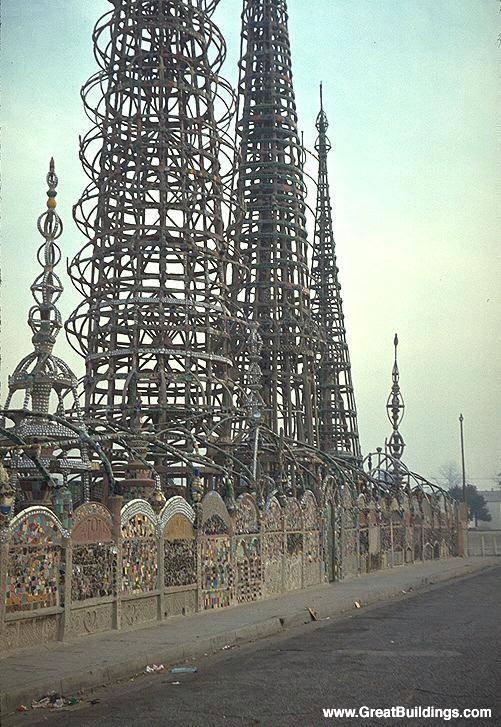
Top photo: Sabato (Simon) Rodia completes the Watts Towers in 1955, which he began building in the early 1920s, and moves out of town. Los Angeles intends to knock down the structures, regarded by many in the city government as a horrific eyesore; today, the towers are part of the California Parks System.

Sylvia Hart Wright: "One man's artistic fantasy is here given substance: fanciful spires pieced together over a period of thirty-three years from steel reinforcing rods and wire mesh, colorfully decorated with seashells and fragments of broken dishes and bottles."

Simon Rodia: "I had in mind to do something big and I did it."

Tuesday, March 14, 2006

1955


Hawkshaw Hawkins, Car Hoppin' Mama.
Carl Smith with the Tunesmiths, Baby I'm Ready.
Webb Pierce and Red Sovine, Why Baby Why.


For a brief moment in the mid-1950s, country music was up for grabs. The past success of harder-edged honky-tonk records and the growing, inescapable presence of Elvis Presley meant that for many country musicians, the way forward was to stomp out even wilder music. But that proved to be an illusion, because in the next few years Nashville execs and producers realized there was a lot more money to be found in crafting ornate, heavily-produced pop/country ballads; thus the rock & rollers were hived off from country "purists", with only the likes of Buck Owens and Merle Haggard left in the next decade to keep things a little frayed.

So enjoy some remnants of a time when "rock & roll" and "hillbilly bop" and even "country/western" were almost interchangeable categories.

First, Hawkshaw Hawkins' take on Hank Thompson's "Car Hoppin' Mama" (maybe it's my sordid mind, but doesn't this sound like an ode to a prostitute? (a rock & roll tradition, if so). The lyrics are weirdly vague about what exactly the singer's girl is up to, besides having a smile that "gets her tips", but hell, he plans to marry her and get her off the beat in any case). While the track is fairly traditional in tone-- dominated by fiddle and steel guitar--Hawkins' smooth delivery gives it a more modern feel.

Harold "Hawkshaw" Hawkins was born in Huntington, West Va., in 1921 and began recording for King Records in the late 1940s. After a dry spell, he signed with RCA, where he served as a utility player--applying his rich voice to whatever they threw at him, ranging from ballads to honky-tonk tunes to R&B covers. Sadly, just as he was enjoying the biggest hit in his career, "Lonesome 7-7203", he was killed in 1963 in the same plane crash that took the lives of Patsy Cline and Cowboy Copas.

"Car Hoppin' Mama" was recorded in Nashville on May 27, 1955, with Chet Atkins on guitar, Walter Haynes on steel and Tommy Jackson and Grady Martin on fiddle. It was released in August as RCA 6211. You used to be able to find it on the now out-of-print Legends of Honky Tonk; now Hawkins, like a lot of 1940s and 1950s country stars, is represented on CD either by massively expensive boxed sets or inferior cut-rate compliations. In any case, "Car Hoppin' Mama" appears to be available nowhere legitimately, so enjoy.

We've already met Carl Smith, the not-quite-heir apparent to Hank Williams, back in the 1953 survey. Smith had movie star looks and a deep, full-throated voice (at this time, he was married to June Carter) but his popularity ebbed with the decade. Still, here's a rocking track, recorded with the Tunesmiths (who included Sammy Pruett, Johnny Sibert and Jimmy Smith on guitars, Dale Potter on fiddle, Bill Simmons on piano and Buddy Harman on drums).

This is the rarer first take of "Baby I'm Ready", recorded in Dallas on Feb. 2, 1955, and released as Columbia 21411 in July. A remade version became a hit a year later. The only place this track is on CD currently is on the colossal Satisfaction Guaranteed set.

And here's Webb Pierce, who's a little cornier than the other singers but still delivers the goods. "Why Baby Why" was written by George Jones and his friend Darrell Edwards; weirdly, the track is basically a Red Sovine recording, as Webb comes in only on harmony vocals on the chorus, yet Webb received top credit and the song is generally remembered as a Pierce hit. In any case, it's a fine song--recorded on October 27, 1955 and released as Decca 29480. On King of the Honky Tonk. Sovine has a bunch of CDs available here.

This post is dedicated to the Rev. Frost, who's been enduring a string of bad luck so far this year. Hang in there, Rev.

Wednesday, March 08, 2006

1955


George Lewis and His New Orleans Stompers, Mahogany Hall Stomp.

I've been guilty, in recounting postwar jazz history in this blog, of acting as if bebop was the only game in town. That's because in part, this is far from a comprehensive history of anything, and because bebop, for me, is some of the finest jazz ever recorded.

That said, it's time to make amends to the moldy figs.

A substantial "traditional" jazz revival also occurred in the 1940s and 1950s, acting as a counterweight to bop and other modern forms ("Dixieland" emphasized tight ensemble playing over extended soloing, etc.), and one of the happy by-products of Dixieland redux was the rehabilitation of the great George Lewis.

Lewis, who, while younger than his rival on clarinet Sidney Bechet, had a style that seemed to hail from a more distant time, was barely known outside of New Orleans until 1942, when Bunk Johnson worked with him, first on recording sessions and later on tour. When Johnson retired, Lewis took over as bandleader.

Spencer Williams' "Mahogany Hall Stomp" is just one of many hot tracks Lewis recorded in the final two decades of his life. Recorded on April 11, 1955, with Lewis (clarinet), Avery "Kid" Howard on trumpet (who basically recreates, note for note, his solo from a 1929 recording of the same song), Jim Robinson (trombone), Alton Purnell (p), George Guesnon (banjo), Alcide "Slow Drag" Pavageau (b) and Joe Watkins (d).

Unfortunately, most Lewis recordings are currently out of print--you can find "Mahogany Hall" on George Lewis and His New Orleans Stompers or on Gary Giddins' compilation Visions of Jazz.

(update) thanks to an anonymous commentor, it turns out lots of Lewis is available on CD after all, on the Jazzology label.

Tuesday, March 07, 2006

1955


Buddy Holly and Bob Montgomery, Gotta Get You Near Me Blues.
Buddy Holly and Bob Montgomery, You and I Are Through.
Buddy Holly and Bob Montgomery, Down the Line.
Buddy Holly and Bob Montgomery, Baby It's Love.


They were the best of friends, as far back as junior high school, in 1949. Charles "Buddy" Holley had been playing guitar since he was a child, but it was meeting Bob Montgomery, who loved Hank Williams, that provided Buddy with his first true style, as well as the impetus for Buddy to begin performing professionally.

By the first years of the new decade, the two had formed a "Western and Bop" band, playing at youth clubs and dances throughout Texas. Bob mainly sang lead--he had a fine voice, albeit one enthralled by Hank Williams' stylings--and they mainly played straight country. But occasionally Buddy would sing, with the resulting oddness that, in the midst of a fairly standard country weeper, we can hear the familiar, loopy voice of "Peggy Sue" and "That'll Be the Day" breaking in.

The two (along with friends like Larry Welborn and Sonny Curtis) began recording demos whenever they could, in tiny studios, like Nesman Recording Studio, in Wichita Falls, Texas. Most were slow ballads, often with interchangeable titles ("Flower of My Heart", "Door to My Heart," "Soft Place in My Heart", "I Gambled My Heart"), but occasionally they would wax a gem, like Montgomery's swinging "Gotta Get You Near Me Blues."


Buddy (L) and Bob (R) flank Larry Welborn

In early 1955, Buddy and Bob opened for Elvis Presley. To say this changed everything is an understatement--Buddy became consumed by Elvis, singing like him (Holly's version of "Baby Let's Play House" from late '55 is almost a note-by-note Presley imitation). By August '55, Buddy and Bob were recording their first true rock & roll songs--here are the stomping "Baby's It's Love" and Montgomery's "You and I Are Through". (The kick-ass "Down the Line" is from this period as well.) Later that year, when Bill Haley came to Lubbock, he left with the demos and passed them on to Decca.

In January 1956, Buddy received a recording contract from Decca, but made out only to him. By all accounts, Bob was magnanimous, urging Buddy to sign and even attending his first recording session in Nashville, where Bob didn't play a note.

We'll be hearing a great deal more of Buddy Holly for the rest of the 1950s. As for Bob Montgomery, he became a professional songwriter, for Buddy ("Heartbeat") and others.

A note: these tracks were recorded under primitive conditions, maintained poorly and then overdubbed (sometimes with way too much drums) a decade later by Holly's producer Norman Petty--so the sound is pretty rough.

Once upon a time, when the fairly good movie The Buddy Holly Story came out in the late 1970s, MCA UK got it together and released a 6-LP boxed set that included nearly everything Holly had recorded. Naturally, the set soon went out of print, and two decades have passed without anything equivalent being issued on CD. The result is that Holly's work is only available piecemeal on disc (you have to buy one for greatest hits, another for early stuff, another for demos, etc.)--for example, most of the Montgomery stuff is on Holly in the Hills/Giant. But if you can find The Complete Buddy Holly (it turns up on eBay fairly regularly) it's greatly worth the investment. MCA is rumored to be sitting on much more unreleased Holly material from this period (including the Grail--the undubbed Holly/Montgomery sessions), but seems to be waiting for perhaps the centennial of Holly's birth to release them...

Thursday, March 02, 2006

1954


Sen. Joseph McCarthy, Address to the Chicago Irish Fellowship Club (excerpt).
Hank Ballard and the Midnighters, Work With Me Annie.
Hank Ballard and the Midnighters, Annie Had a Baby.
Sons of the Pioneers, Sierra Nevada.
Moon Mullican, What's the Matter With the Mill.
Shirley Gunter & the Queens, Oop Shoop.
Margie Day, Take Out Your False Teeth Daddy.
Lowell Fulson, Reconsider Baby.
The Robins, Riot in Cell Block No. 9.
The Cadillacs, Gloria.
John Lee Hooker, Gotta Boogie.
Sarah Vaughan w/Clifford Brown, September Song.
The Spaniels, Goodnight Sweetheart Goodnight.


To wind down 1954, take a spin around the radio dial again.

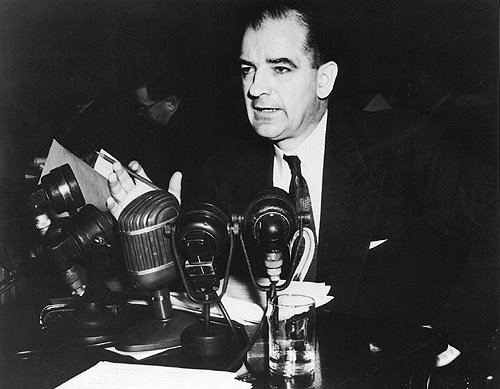
On St. Patrick's Day, Senator Joseph McCarthy gave a speech in Chicago in which the usual slurs and allegations about hidden Communists had curdled into something far stranger--there is a bloodlust, almost a wish for death, in his words. Listen, in this excerpt, to the relentless way he keeps tasting the word "Communist," building up to where, almost ecstatically, he describes how Communists "ordered American BOYS to have their HANDS wired behind their BACKS." The next month saw the beginning of the Army-McCarthy hearings, his Waterloo.

Hank Ballard and the Midnighters' "Work With Me Annie" and "Annie Had a Baby"(a made-to-order sequel inspired by a DJ's joke, after playing "Work With Me", that Annie was going to have a baby) sparked a virtue panic among parents, who were horrified to find out their children were listening to blunt odes to sex (and its consequences). Each generation, the farce happens again (cf. "Darling Nikki"). Hank Ballard, who grew up singing in church, is just one of many rock & roll prodigal sons. On Sexy Ways.

The old West, or at least the happy simulacrum of it created in the 1930s and 1940s, was beginning to fade--the Sons of the Pioneers' "Sierra Nevada" is among their last recordings, a pleasant wish for reconciliation, or maybe oblivion. On Hall of Fame Series.

Moon Mullican took the remnants of Western swing and stomped on them--he was laying the trail for Jerry Lee to follow. "Mill," originally by Memphis Minnie, is on Moonshine Jamboree.

"Oop Shoop," by Shirley Gunter, is early girl group bliss, while Margie Day's "Take Out Your False Teeth Daddy," one of the odder and more grotesque double-entendres ever recorded, was a minor R&B hit. Find both here.

Lowell Fulson's electric blues "Reconsider Baby," his first hit for Chess, has such a swagger that you wonder just how hurt Fulson because his girl is leaving him--his eyes are already elsewhere. Find here.

The Robins' "Riot in Cell Block No. 9," was one of the first major Lieber/Stoller hits and one remade a few years later by the Coasters. The Robins' bass singer Bobby Nunn hated the lyrics, so they got Richard Berry, who was hanging around the studio, to sing the lead. The result was a track astonishing in its viciousness--"Pass the dynamite, 'cause the fuse is lit", with drum fills that sound like fists pounding on cell bars.

The Cadillacs' doo-wop hymn "Gloria", released in the summer of 1954, is on the essential Doo Wop Ballads.

"I hear papa tell mama/let him boogie." So John Lee Hooker does, with eight bars of the rawest guitar work possibly ever recorded. On Legendary Modern Recordings.

Sarah Vaughan's masterful take on "September Song" is aided by Clifford Brown on trumpet, Herbie Mann (flute) and Paul Quinichette (tenor sax). On Sarah Vaughan/Clifford Brown.

And say good night with the Spaniels.

Films of '54


A pretty weak year, esp. for Hollywood (Three Coins in the Fountain, The Silver Chalice, blecch, etc., blecch), but a few masterpieces got made, so who's to complain.

Rear Window.
Hitchcock made more perverse films, scarier ones, stranger ones, but this is likely his most perfect. Plus Grace Kelly at her most overwhelmingly gorgeous.
Seven Samurai.
Johnny Guitar. "You all think she's some fine lady and that doing nothing makes you fine gentlemen. Well she ain't! And you're not!"
Sanshô dayû (Sansho the Bailiff).
Them!
Track of the Cat. If Eugene O'Neill's Tyrone family had found themselves trapped in a Western.
La Strada.
The Far Country.
Garden of Evil.
Time Out of War.
Yama no oto (Sound of the Mountain).

Yeah, I know, I didn't list On the Waterfront. I really just don't like it. Make your case for it in the comments, if so inclined.

That's it. Next up: 1955, one of the greatest years for pop music in the 20th Century, so any overview is only going to scrape the skin of the surface. Still, we'll give it a shot.

Thursday, February 23, 2006

1954


Harmonica Frank Floyd, Rockin' Chair Daddy.
Kenneth Banks, High.


Sam Phillips had finally found what he wanted. It had happened just in time: the blues musicians who Phillips had been recording since 1950 were getting difficult to sign--with growing demand for R&B records from teenagers, inculcated into the music by DJs like Alan Freed, suddenly the obscure and penny-ante business of taping blues artists was becoming competitive and lucrative. By 1954, Phillips had been in legal brawls with larger labels, had watched his most established artists (like Junior Parker, who broke his Sun contract to sign with Duke) fly away and realized that, lacking the budget of an Atlantic or Chess, he was going to be consigned to the minor leagues.

Then, of course, came Sun 209, "That's All Right"/"Blue Moon of Kentucky", in July, and Sun 210, "Good Rockin' Tonight/"I Don't Care If the Sun Don't Shine", in September. Having at last hit a vein of gold, Phillips greatly curtailed his recording sessions so that he could market and promote Elvis Presley.

So Sun blues records became increasingly rare--by 1956, they were all but extinct. One of the last examples of the wild, guttural blues Phillips had routinely captured on disc for four years was Kenneth Banks' "High"--a vulgar, honking glorification of getting rocked to the gills, featuring some psychotic guitar work by Pat Hare (he of "I'm Gonna Murder My Baby" infamy). And "High", like many Sun blues recorded in the mid-'50s, was never released.

As the Sun Records: Blues Years set puts it, Banks is "another blank ledger in the filing cabinet of blues biography." Little is known about the man, other than he was a regular bassist on Sun sessions. "High", recorded on January 8, 1954, featured Mose Vinson on piano and Houston Stokes on drums. Find here.

And when Phillips began recording again in earnest, he focused more on country music--particularly wild, jet-age hillbilly bop. Soon enough would come Perkins, Cash, Orbison and the Killer.

However, Phillips' first attempt to find this sort of country-fried rock & roll had been in 1951, when he recorded an intinerant singer/harmonica player named Frank Floyd. Floyd, born in Toccopola, Mississippi in 1908, had bummed around the country for 40 years, working odd jobs, playing in medicine shows, woodman halls, and on street corners. (Much of the information on Floyd comes from Greil Marcus' Mystery Train.)

Who knows how Floyd and Phillips found each other, but in '51, Phillips was hungry for something he could barely define. "Gimme something different," Phillips told Floyd in the little studio on Union Ave. "Gimme something unique." Phillips passed on the tracks that came out of the session to Chess Records, which released some sides that utterly flopped. This was odd, screeching, simply weird music that no one wanted to hear--the Floyd singles could have been slipped in among the host of scratchy 1920s sides that Harry Smith would collect the following year on his American Folk Music anthology, and none would have been the wiser.

In spring 1954, Phillips and Floyd tried again. The result--Sun 205, "The Great Medical Menagerist"/"Rockin' Chair Daddy", was Phillips' first true rock & roll single, a boast sung by a wild 46-year old man who likely would have scared the hell out of most of the teenagers who bought the record.

Well I never went to college

And I never went to school

So when it comes to rockin'

I'm a rockin' fool!


"Rockin' Chair Daddy" is on Sun Years Vol. 1.


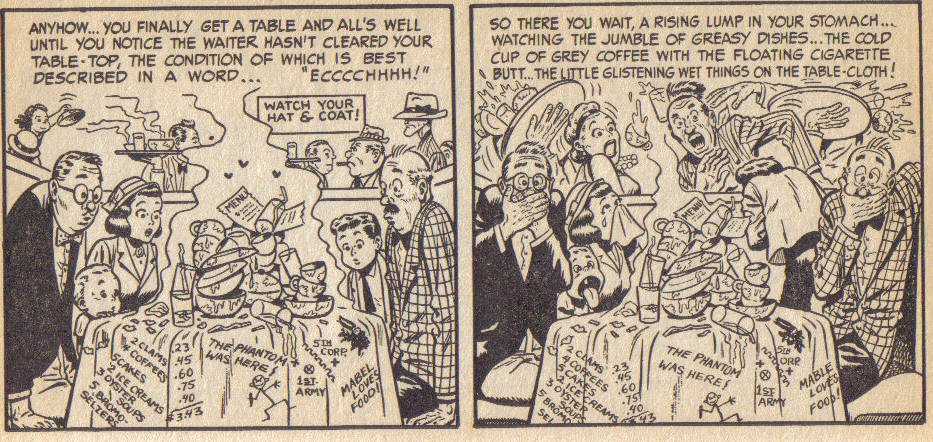
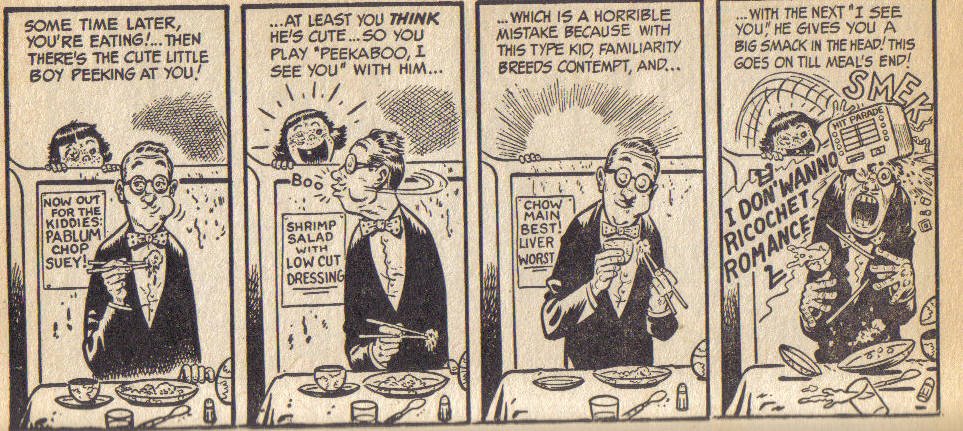
In September '54, one of the greatest bits of American humor ever published (in my opinion, of course) appeared in Mad magazine (issue #16). Called "Restaurant!", it was drawn by the brilliant Will Elder, the Brueghel of comic books, and detailed a hapless family's attempt to get served at a overcrowded chow-mein restaurant, with so much bizarre detail crammed into the margins and backgrounds that ten or twenty reads are needed to get all of it in. I first came across it in The Bedside Mad, one of the best anthologies of the early Mad days, and it's been making me laugh for over 25 years.

Bonus Round

Today's my birthday, so here are some tracks reflecting my state of mind:

The Pretenders, Middle of the Road.
Traveling Wilburys, End of the Line.


"Maybe somewhere down the road aways/You'll think of me and wonder where I am these days. " RIP Roy and George. And to the rest of you, happy weekend.