
The Byrds, Chestnut Mare.
Al Duffy and Tony Mottola, Light Cavalry Overture.
R.E.M, Bandwagon.
When the Man and the Dog came back from hunting the Man said, "What is Wild Horse doing here?" And the Woman said, "His name is not Wild Horse any more, but the First Servant, because he will always carry us from place to place to place for always and always and always. Ride on his back when you go hunting."
Rudyard Kipling, "The Cat That Walked By Himself," Just So Stories.
The other day I was driving along a narrow valley road and, as I curved around one blind turn, I saw a man sitting astride an enormous grey horse. Man and horse stood in the mouth of a gravel driveway that spooled down into a dell, as though they meant to defend the entrance by force. Now horses are no great novelty in the fairly rural area where I live, but I rarely see people riding them. The horses mainly stand out in the fields, looking off to the mountains, having done with mankind.
So a man (a great chunk of a man, as it turned out) atop a horse that stood at perhaps fifteen hands was a bit shocking. A man on horseback seems noble, threatening and a bizarre anachronism, as though you spotted someone on the street wearing a ruff and brandishing a saber. It all felt a bit like the past silently judging the present, and finding it wanting.
If walking remains, if embattled, a common method of transportation, horse riding, or riding any beast for that matter, sometimes appears to be on the verge of winking out. There will always be riders, of course, as long as there are the wealthy, the established and those who want to be either, and riding is still commonplace in the less overrun sections of the United States. But a person born today, or even thirty years ago, stands a good chance of never riding a horse in their lifetime. My only experience riding dates from my Virginia childhood, and my memories of the event are so dim that they've been long supplanted by the pair of photographs taken of the ride: me atop a brown pony, standing in what appears to be a field of straw.

To make a ridiculous generalization, the history of riding is that of civilization--a brutal phase of conquest and domestication, an era of great horseback warriors (Alexander the Great, tramping through Persia on his bull-headed Bucephalus), an aristocratic age when only the powerful and rich rode, a great democratic era in which even the poor owned mules and donkeys. And now, in our current muddle of a time, riding is a sport for the dedicated wealthy; a colorful way to gamble; an intensive, costly hobby, like black-and-white film photography; or a weekend novelty, a trip to an outdoor museum where you can mount the exhibits.

and of course, Henry the Horse dances the waltz
Yet man and horse were once the greatest of partners. Horses (and mules and asses) made hunting easier and more productive, made agriculture feasible, and were the bringers and defenders of empires, from the Romans to the Mongols. The horse is in the psychic depths of the human race: they are the root of the most common of phrases (nightmare, horsepower) and horses tramp through our dreams, myths and religions, whether as centaurs or Valkyrie mounts, from Odin atop Sleipnir to Christ riding an ass into Jerusalem to Mohammed journeying through the heavens on al-Burak (below).

The ego’s relation to the id might be compared with that of a rider to his horse. The horse supplies the locomotive energy, while the rider has the privilege of deciding on the goal and of guiding the powerful animal’s movement. But only too often there arises between the ego and the id the not precisely ideal situation of the rider being obliged to guide the horse along the path by which it itself wants to go.
Sigmund Freud, New Introductory Lectures on Psycho-Analysis, Lecture 31, 1933.
Songs about riding tend to fall into specific categories (as though mirroring the various breeds of horses), such as racing songs, labor songs, fairy-tale ballads, cowboy songs, Hollywood cowboy songs. They're often filled with quests and dreams, they tend toward the epic whenever possible, and they currently seem to be out of fashion, as most of the riding songs written in the past few decades seem deliberately nostalgic. (And if not, then they're utterly cheesy, like Dan Fogelberg's "Run for the Roses" or whatever wretch was responsible for "Wildfire".)

Three initial sallies:
The Byrds' "Chestnut Mare," from 1970, is the last great Byrds song and possibly the strangest, a tall tale that is also an erotic ode to a horse. (You could place some of the blame on co-lyricist Jacques Levy, who directed Oh! Calcutta! and also helped Dylan write some of Desire.) "Mare" is from a stillborn Byrds' rock opera called Gene Tryp, a remaking of Ibsen's Peer Gynt as a psychedelic Civil War drama (the Byrds had a number of odd failed projects--Roger McGuinn once envisioned a double-LP that would encapsulate the history of music, beginning with folk ballads and ending with Moog synthesizers).
Goofy lyrics aside, what drives the song is Clarence White's guitar, offering a subtly different phrase after nearly every line, and the chorus, which breaks upon the listener like a wave. Recorded 4 June 1970; on Untitled.

Nicholas Sarkozy, on white horse
"The Light Cavalry Overture" was composed by the Austrian conductor Franz von Suppé in 1866, as, unsurprisingly, the overture to his opera The Light Cavalry. (Sample here.) The overture's driving pace, galloping in triplets, made it a regular feature of Hollywood movies of the '30s and '40s, including Mutiny on the Blackhawk, Stars and Stripes Forever and a host of Warner Brothers cartoons.
Here's a version by violinist Al Duffy, who played for Paul Whiteman and the Bell Telephone Orchestra, and the guitarist Tony Mottola who was one of Frank Sinatra's favorite session players and would go on to have a long career in television. They rage through the piece, even throwing in "Jingle Bells" at one point. Recorded 5 May 1944; the only place to find it is on the not-cheap but absolutely essential That Devilin' Tune, Vol. 3. (Duffy died this past December--he lived to be 100 years old.)

And R.E.M.'s "Bandwagon" is one of the goofiest tracks the band ever recorded, and seems, along with tracks like "Voice of Harold," to suggest an alternate history for the band, in which they were a beloved country music novelty act. Peter Buck said R.E.M. called this "the fruity song" because of what he called its "stupid chord changes." Released in June 1985 as the b-side of "Can't Get There From Here"; on Dead Letter Office. (If you haven't been reading Matthew Perpetua's song-by-song R.E.M blog, take a look.)
The First Servant

Spotted horses ca. 20,000 B.C., Pech-Merle cave, France.
National Promenade Band, The Horse Trot.
Los Congos del Espiritu Santo, Ensilla Mi Caballo (Saddle My Horse).
Woody Herman and His Woodchoppers, Four Men On a Horse.
Duke Ellington, Caravan.
Martin Denny, Caravan.
Mary Lou Williams, Caravan.
The horse! The horse! The symbol of singing potency and power of movement of action in man.
D.W. Griffith.
The great families of hominidae and equidae, future collaborators in the domination of the world, spent a great many centuries trying to kill or escape from each other.
At the end of the last ice age (10,000 B.C. or so), humans had begun hunting the various members of the equidae family--the wild asses (equus africanis) in North Africa, zebras (equus burchelli) throughout Africa and some odd ass-hybrid, now extinct (equus hydruntinus) in Southern Europe. The most treasured beast, however, was the wild horse--equus caballus--the fastest and largest of the clan, prized for its meat and skin. Over time, man came to be quite adept at killing the horse, whether by driving a herd off a cliff or by waiting in large numbers in a narrow valley or crevice, hoping for a herd to squeeze by.

At some point, perhaps around 4,500 B.C., the horse was domesticated and first ridden by humans. You could say perhaps the horse, facing extinction, gave up living in the wild and sold out, much like his compatriot the dog, nature's finest con artist, who learned quite early that there was a great deal more food to come out of befriending man than in attacking him. Domestication was likely not some grand man-versus-beast struggle, in the way of many Western movies where some cowboy gets in a corral with a bucking horse and subdues it via stealth and mojo. It may well have been that some humans, while slaughtering a herd, found the foals cute and took them back to their camp, thus raising a generation of horses that had only known captivity.
He came nearer and heard a crunching of gilded oats, the gently champing teeth. Their full buck eyes regarded him as he went by, amid the sweet oaten reek of horsepiss. Their Eldorado. Poor jugginses! Damn all they know or care about anything with their long noses stuck in nosebags. Too full for words. Still they get their feed all right and their doss. Gelded too: a stump of black guttapercha wagging limp between their haunches. Might be happy all the same that way. Good poor brutes they look. Still their neigh can be very irritating.
James Joyce, Ulysses.

The sound of the horse--whether the rapid pulse of the gallop or the waltzing sway of the canter--is an age-old feature of music, regardless of culture. Where walking rhythms are typically unvarying 4/4, the ancestor of everything from rock & roll to house, horse rhythms are more complex: shifting, swaying, adding different textures, changing time signatures more often than the band Yes--and they have been conveyed by everything from woodblocks to maracas, from bongo drums to the organ synthesizer that my grandmother owned in the late '70s, with the "gallop" switch located next to the "bossa nova" one.

Alastair Robinson, "Horse riders on the edge of the Sahara, Ouarzarzate, Morocco," 2005.
Three equine inspirations:
"The Horse Trot," from 1913, is by the National Promenade Band and was released as Edison Blue Amberol 2076. The National Promenade Band was your standard-issue recording outfit in the early 20th Century, offering various fox trots, marches, polkas, and even the "hurricane two step." Courtesy of the amazing Cylinder Preservation and Digitization Project.
"Ensilla Mi Caballo" ("Saddle My Horse") is performed by Los Congos del Espiritu Santo, from the Dominican Republic. Los Congos consisted of Vicente Vargas, alcahuete (a small drum), Donatilia Vargas, canoita (a sort of woodblock struck with a stick), Albertino "Moreno" Gradiano, maracas, Victoriano Fortunato Vargas, palo mayor (a five-foot high hollow drum), and Bienvenida Vargas Depozo, the lead singer and another maracas player. Recorded January 1976 in Villa Mella, D.R.; on Music from the Dominican Republic, Vol. 3.
And "Four Men On a Horse" is by four members of Woody Herman's Woodchoppers--songwriter and master bassist Chubby Jackson, Jimmy Rowles (piano), Billy Bauer (guitar) and Don Lamond (d). One of the first bebop-inspired compositions Herman's band recorded, "Horse" features a restless, varying time structure: sometimes the track clips along, sometimes it stops dead. Recorded in Chicago on 16 May 1946 and released as Columbia 37227. The track is not available on CD, as far as I can tell--I got it off a compilation LP called The 1940s: The Small Groups--New Directions.

Team of mules and zebras, Transvaal, 1895.
One of the first tasks for the domesticated horse and ass was to serve as a brute labor force--hauling carts, dragging plows--but by 2,000 B.C. or so, horses were pulling Mesopotamian chariots, and a millennium later, riding horses had become widespread throughout Europe and Asia. (It was the Chinese, around the time of Christ, who likely invented the stirrup, though the Indians may have done it first.) The growth of metallurgy, leading to stronger, more durable wheels and carts, and simply the sheer amount of stuff that human beings now had--trade goods, crops, slaves--led to a vast increase in horse-, mule- and camel-driven caravans, linking Egypt with Persia, India with China.
From China to the Atlantic, and from the northern Taiga to the Indian ocean the old world was threaded all across with pack trails snaking from water to water over the deserts and pastures, the forests and the hills...From China to Europe was a three years' journey, not because of the distance but by reason of the robbers who made the trail unsafe. At each market town the packtrain captains waited, perhaps for months, until a caravan assembled sufficiently large to undertake the journey.
Roger Pocock, Horses.
"Caravan" was written by Duke Ellington and his trombonist, the Puerto Rico-born Juan Tizol. Tizol was a valve trombonist, rather than a slide trombonist, which allowed him to play faster and across a wider range, and "Caravan" begins with Tizol offering the main theme while Harry Carney hovers beneath with a simple, repeating countermelody; then Cootie Williams appears on trumpet, squawking and buzzing around the menagerie.
Recorded 14 May 1937 (the same session they cut "Azure"!) and released as Master 131; on Masterpieces. (Here's a phenomenal live performance from 1952, with Tizol center stage, and Ray Nance on violin.)
"Caravan" was covered by seemingly everyone and their mother in the '40s and '50s, ranging from Perez Prado to Art Blakey to Bill Haley and His Comets. Cover versions either played up the "exotic," with shrieks, chimes and a slow, swaying beat (such as Martin Denny's 1959 rendition), or kicked up the tempo so that the caravan seems to be booking along at 70 mph. (Denny's take, recorded in July 1959, is on Exotica III.)

Child camel riders, United Arab Emirates.
My favorite version of "Caravan" is an obscure Mary Lou Williams solo piano recording from 1944. Williams' take centers on Tizol's main theme, which Williams' right hand dances out, while her left offers a few ominous chords. Sometimes Williams flies away--one phrase sounds like a bop interpretation of a Debussy Prelude--but she always comes back to the theme, dancing and brooding.
At the time she recorded this track for Moses Asch, Williams was playing regularly in New York at Cafe Society Downtown, an integrated club, co-founded by members of the Communist Party's Popular Front, that was so purist it banned cigarette girls. She had been working with Ellington for some time, doing arrangements, and had grown bored with the band, which she felt was in a funk. Until one night, she heard "Caravan":
This particular time we were in Ohio. I said, 'I'm gonna listen one more night, but I want to get out of here and leave.' And I'm telling you, when that band hit, I've never heard anything like that before in my life. And I think everybody else was just in hysterics or something. Duke was vamping. They played 'Caravan.' When the band hit, his vamp--I never heard anything like that before. It sounded like Stravinsky and I said, 'Well, this is the greatest band on earth.'
Williams' "Caravan" is on 1944, a CD that's close to being out of print, if not already.
Horse Nobility

In hierarchical order: Queen Victoria, Princess Louise, horse, John Brown.
Robin Hendrix, Ride a Cock-Horse to Banbury Cross.
Robert Schumann, Kinderszenen: Ritter vom Steckenpferd (Knight of the Rocking Horse).
Jacky, White Horses.
XTC, Holly Up On Poppy.
So proud that Bolingbroke was on his back!
That jade hath eat bread from my royal hand;
This hand hath made him proud with clapping him.
Would he not stumble?...
Forgiveness, horse! why do I rail on thee,
Since thou, created to be awed by man,
Wast born to bear? I was not made a horse;
And yet I bear a burthen like an ass,
Spurr'd, gall'd and tired by jouncing Bolingbroke.
Shakespeare, Richard II.
A genial view of humanity has it that at the dawn of history, no man was greater than his neighbor; a more cynical view assumes that there always was some form of hierarchy, even up in the trees. And the initial whispers of aristocracy, the first morning of the Second Estate, may lie in the simple fact of transportation. That is, the common people, for most of our history, have always walked; the uncommon have always ridden.
Isn't there something inherently aristocratic about riding? Think of the great horsemen and horsewomen, and you generally come up with a collection of knights, royalty and their at-times grotesque descendents, victorious generals, crusaders, wizards, cowboys and Indian chiefs. Horses are embedded in the very names of nobility--the Latin equus leads to equites, the old Roman cavalry and ruling class, and, later on, esquire; the French cheval bred chevalier and chivalry; the Spanish caballo gives us cavalier, and so on.

If walking is fundamentally democratic (most everyone can and should walk, though many don't), riding seems a fundamentally elite practice. Perhaps it lies in the very nature of riding--a horse is larger, stronger and more impressive than a human, so for a human to ride a horse, to make an amazing beast submit to his or her will and make the horse run for miles or perform tricks, indicates some measure of skill and power. There's also the simple matter of economics--for much of human history, horses were relatively scarce and extremely valuable. Feeding and caring for a horse was beyond the means of your typical peasant, and having a stable full of horses was usually only the province of kings.

Further, horseowners and nobles share another obsession: tracing bloodlines back for centuries. Is there any other animal whose ancestry is so fussed over? The horse is a eugenicist's dream, with breeds emerging from elaborate, dedicated attempts to perfect genetic selection, as breeders tried to make horses larger, swifter, and ever more powerful.

Take the Arabian horse, for example, which emerges out of myth and the desert some 3,500 years ago. The Arabian's ancestry is more renowned than that of any European royal family--the Arabian was said to have been bred via the efforts of Ishmael, Abraham’s cast-out son, or Baz, a descendant of Noah. The Bedouin horsebreeders would often race each other’s finest, with the loser’s herd providing breeding stock to the winner’s.
The great rulers of the Middle East were tied to the Arabian. King Solomon, disregarding Mosaic tradition (in Deutoronomy 17:16) that “the king shall not multiply horses to himself,” established a vast stables of Arabian horses in Jerusalem. And there is a legend in which the prophet Mohammed deprives 100 of his best horses of any water for three days, then sets them loose. As the hundred horses stampede toward water, Mohammed sounds a battle horn, to which only five mares respond. These mares became the Five Mares of the Prophet--their progeny were called asil, Arabian horses of pure blood.
The Arabs, once converted to Islam, became great horse-warriors, driving through and conquering all of what was once Roman Africa, up into Spain until they were finally checked in France by Charles Martel, who pushed for the Arabian horse to be imported into the European kingdoms, a slow immigration that went on for a millennium.

Charles I on horseback
And horses, throughout myth and memory, gratefully bear the weight of princesses, knights, grand ladies, emperors and even gods. Children, early on, come to associate horses with magic and power. The children's rhyme "Ride a Cock Horse," for instance, is allegedly about Queen Elizabeth I's visit to Banbury to see a new stone cross that had been erected upon a hill. The hill was so steep, however, that a cock-horse (a stallion) had to be enlisted to haul Elizabeth's carriage up to the summit. When a carriage wheel broke, Elizabeth simply mounted the horse and rode up herself, to musical accompaniment provided by the Banbury villagers.
That story seems a bit suspect--it smacks of something the Banbury board of tourism would devise. Other competing origins have it that Lady Godiva was the equestrienne, or that the "fine lady" of the rhyme is actually a pun on "Fiennes," the name of a wealthy local family. In any event, the Banbury Cross was destroyed by Puritan zealots around the time of Elizabeth's death; some 250 years later, Queen Victoria ordered it to be rebuilt.
The rhyme "Ride a Cock Horse" was first printed in the late 18th Century, but likely had been circulating for years beforehand. Robin Hendrix's version is from a recent record called Nursery Rhymes and Nursery Tunes (also available on iTunes, which, in a bit of modesty, lists the track as "Ride a C*** Horse").

And Robert Schummann 1838's composition Kinderszenen ("Scenes from Childhood"), Op. 15., featured a brief adventure of a knight on a hobbyhorse, complete with wild galloping. (Weirdly enough, "Ritter vom Steckenpferd" is sometimes translated as "Ride a Cock Horse" though there's no connection with the nursery rhyme at all.) Performed by Jurgis Karnavicius; on Schumann: The Romantic Piano, also on eMusic.

The one thing I do not want to be called is First Lady. It sounds like a saddle horse.
Jacqueline Bouvier Kennedy.
The horse continues to be associated with power, wealth and mastery: to use one minor example, take how horses keep reappearing in gangster stories, whether it's the decapitated horse Khartoum in The Godfather, whose head is placed in the bed of a movie mogul who needs convincing, or the doomed Pie-O-My, Tony Soprano's favorite horse, whose suspicious death leads Tony to brutally kill his psychotic captain (and best earner) Ralph Cifaretto.

Two equestrienne fantasies:
"The White Horses" was a television show from 1965, co-produced by Germany and Serbia, filmed in Slovenia, and starring an Austrian actress (it was like a reunion of the Central Powers). This is the UK version's theme song, from 1968, sung by the '60s mayfly Jacky (Jackie Lee). While it's likely a great many European readers know this song by heart, I had never heard of it until Dean and Britta covered "White Horses" on their recent record. (Anyone by chance seeing Dean & Britta in Northampton, MA, in July?) On Leaders of the Pack.

Chagall, Equestrienne.
"Holly Up On Poppy," Andy Partridge's ode to his daughter on her rocking horse, is from XTC's 1992 album Nonsuch. Originally called "Holly High On Poppy," until Partridge realized he'd accidentally written a dope song. Holly Partridge is now a session singer in the UK.
Knights Errant

Charles Trenet, Vous Oubliez Votre Cheval.
Eddy Arnold, Tennessee Stud.
Howlin' Wolf, Saddle My Pony.
Whenever the horse stopped (which it did very often), he fell off in front; and whenever it went on again (which it generally did rather suddenly), he fell off behind. Otherwise he kept on pretty well, except that he had a habit of now and then falling off sideways; and as he generally did this on the side on which Alice was walking, she soon found that it was the best plan not to walk quite close to the horse.
"I'm afraid you've not had much practice in riding," she ventured to say, as she was helping him up from his fifth tumble.
Lewis Carroll, Through the Looking Glass.

The horse has been a part of warfare since the Mesopotamians and Greeks, and seemingly every famous warrior has had his own legendary mount, whether the Duke of Wellington's Copenhagen, which carried him at Waterloo, or Robert E. Lee's Traveller, or Richard III on White Surrey (the latter's death on Bosworth Field leads to the classic/cliche line "my kingdom for a horse.")

The era of knighthood was relatively short--beginning around the time of Charlemagne, and reaching a zenith between 1100 and 1300, when knights were considered the only true soldiers, pledging service to whichever king or lord supported them. But by the 15th Century, and with the rise of more powerful centralized monarchies with standing armies, the knight began to be seen as, if not a danger needing to be crushed (e.g., the Templars), then an obsolete figure.
The popular idea is of a great ponderous carthorse, standing about seventeen hands, onto which the armored warrior had to be hoisted on a crane...the crane business is pure nonsense, invented by a modern theatrical producer as a funny gag. No the medieval war-horse was a good, strong working horse, like the old bus horses that few remember now.
R. Ewart Oakeshott.
In a chanson written around 1360, the French poet Eustache Deschamps, who mainly spent his time bemoaning life, instead offered a detailed schema of the types of warhorses suitable for nobles. There are three primary horses, Deschamps wrote--the destriers, the Horse of Kings, suitable for the joust (tall and majestic and strong), the coursers, ideal for mounted battle (they were lighter and swifter than the destrier), and the rounseys, horses of less noble breeding, fit for warriors not born into the nobility.

As the mounted knight faded in prominence, he grew all the more potent in legend. Great journeys by horse (like walking pilgrimages set in a grander key) became a standard trope in poems and stories, and reoccur throughout history as well: think of Paul Revere's midnight ride, or the highwayman Dick Turpin, riding Black Bess from London to York in 15 hours.
And with the rise of brutal, mechanized warfare, there came the great rides of utter, deadly futility, whether the Charge of the Light Brigade in the Crimean War, or the Polish cavalry's battles against Nazi German forces in 1939 (the Polish actually succeeded for a few days).

Dicksee, La Belle Dame Sans Merci.
We jumped the infantry positions. Below us, in the trenches, the men were just receiving their evening mess...the air was filled with the smell of smoke and coffee. Several chevaux-de-frise were moved aside so that we could pass, and we continued on our way. The advance sentries looked after us in silence as we rode into the unknown, in style already belonging to times long past, and in dress and arms equally antiquated.
Alexander Lernet-Holenia, Baron Bagge.
One of the eeriest cavalry rides in literature, and one which seems to be a fitting end to the knight, is Alexander Lernet-Holenia's 1936 novella, Baron Bagge. The title character, a minor Austro-Hungarian noble, enlists in his country's cavalry after World War I begins, and finds himself in a battered division based in Hungary which is headed by a vain lunatic Semler, whose other officers include an American from Kentucky in the war for kicks, and whose riders are a bunch of "Galician Poles." Told to scout out advancing Russian positions, Semler instead orders the cavalry into an apparently suicidal charge over a bridge into a Russian-held village on the Ondava River, in what is now eastern Slovakia.
The cavalry division somehow miraculously survives the assault, and then things grow increasingly odd. They ride to a village where everyone is drunk and endlessly celebrating, despite the fact that the Russians should have taken the town weeks before. Bagge encounters a girl he's known about since childhood, immediately falls in love and is married. There are no signs of the Russians, or even any animals. The troupe rides on to the Carpathian mountains, past empty villages, until they at least reach a bridge of gold. They are riding towards death, as it turns out--there is nowhere else left for them.

The last cavalry charge: Poland v. the Wehrmacht, 1939
One thing we often neglect in recounting the many wars of human history is the horrific casualty rates of animals, especially horses. In the 20th Century, some 300,000 horses were killed in the Boer War alone, and somewhere around eight million horses, mules and camels were slain in the course of the First World War. Thankfully for the horse and mule, human technical ingenuity finally freed them of their servitude before the Second World War began--the mule was replaced by trucks and jeeps, the horse by airplanes and tanks. (That said, as the war deteriorated for Germany, the Nazis began using horses more and more, as the horse fields of East Prussia were not considered bombing targets.)
And so the past sixty years, while bloody as usual for mankind, have been the longest era of peace for horses that the animals have likely ever known.

Three modern quests on horseback:
"Vous Oubliez Votre Cheval" (You're Forgetting Your Horse), from 1936, begins with a stranger, wearing a sombrero and with a Toulouse accent, arriving in town and leaving his horse in a hotel cloakroom. Fifty years later, a jockey pretending to have been a sailor is ridiculed by his grandchildren. It's a weird song, to put it mildly (lyrics (in French). On 48 Titres Originaux.

"Tennessee Stud," written by Jimmie Driftwood, was recorded most notably by Eddy Arnold in 1959 and Johnny Cash a few decades later. The story is your typical sort of quest--after being chased away from the woman he loves by her father and thuggish brother, our rider heads down to Mexico, races bulls, kills a gambler, then returns to Tennessee, whips his girl's father and brother, and all's well that end's well.
Released in June 1959 as RCA 7542; on RCA Country Legends.

And Howlin' Wolf's "Saddle My Pony", subtitled "Gonna Find My Baby Out in the World", finds Wolf ready to head out into the wild in search for his lost girl, or something else he can't quite define. Recorded in Memphis on 17 April 1952 and released as Chess 1515 c/w "Worried All the Time"; on 1952-53.
Riding the Range

Dave Fredrickson, A Cowboy's Life Is a Very Dreary Life.
The Skillet Lickers, Ride Old Buck to Water.
Gene Autry, The Last Round-Up.
Sons of the Pioneers, Ride Ranger Ride.
Range Riders, Range Riders Stomp.
Vaughn Monroe, (Ghost) Riders in the Sky.
Tex Ritter, Blood On the Saddle.
Frankie Laine, Blazing Saddles.
The Marshall Tucker Band, Desert Skies.
A light chestnut stallion which presently died.
An excellent chestnut mare for sport and for racing.
A light chestnut stallion, with three white feet; no good.
A silver grey mare, barren. Fair, but a poor racer.
A dun stallion with black points, does not go well...
Bernard Diaz del Castillo, inventory of horses in the fleet of Cortez, 1519.
The cowboy on horseback, the American symbol loved and loathed by much of the world, is the descendent of the Spanish invasion of the Americas and a few Hollywood producers.
The horse long had been extinct in North and South America before the Spanish arrived (though there are theories the equids had originated in what would become the American landmass, which would make the arrival of Columbus and Cortez a strange homecoming for the horse). Once horses began to spread across both continents, it led to great changes for the various Native American tribes--the Sioux, for example, were once a forest people, living in the headwaters of the Mississippi River, until they were pushed out into the Great Plains and became some of the finest horseriders in the West.

After enough Indians had been killed or hounded off of their former lands, the West was considered fit for settlement, and a great many Civil War veterans headed West to supervise the great cattle herds now littering the plains. By the end of the 19th Century, these cowboys (about 30% of which were either black or Mexican) had become semi-mythical figures, known for their outfits and songs. Cowboys sang to stave off boredom or sleep, or to quiet skittish cattle, and a typical cowboy ballad often had its origins in a scrap or two of verse the cowboy half-remembered from a local newspaper, which was then set to a standard English/Irish tune and sung either a cappella or with minimal accompaniment (fiddle, jew's harp).
One cowboy standard is "A Cowboy's Life Is A Very Dreary Life," performed here by Dave Fredrickson, from 1963's Songs of the West. It's typical of the old cowboy songs in that it's not very melodic (it's sung flatly by Frederickson, who was inspired by a recording of an old cowboy, Sloan Matthews of Alpine, Texas) and its subject matter is realist to the point of despair. Ballads like "Dreary Life" or "When the Work's All Done This Fall" are often filled with boredom, weariness and death, a cowboy's regular companions.

As an alternative, there was also the "Southern" horse song--ballads and reels that had mutated from old Irish/Scotch tunes. Take the Skillet Lickers' "Ride Old Buck to Water," from 1930: compared with the typical "Western" cowboy riding song, "Buck" seems dense, muddy and constricted, moving at a wild clip and with a near-incomprehensible lyric.
(The Skillet Lickers were a supergroup of sorts, a bunch of country pros brought together in the recording studio, including Gid Tanner (banjo), Lowe Stokes (fiddle), Riley Puckett (guitar, vocal) and Clayton McMichen (f). "Ride Old Buck" was recorded in Atlanta on 4 December 1930; on Old-Time Fiddle Tunes.)

As massive ranches replaced the open range, and what were once wild territories were converted into boring law-abiding members of the United States, the cowboy's era was ending just as Americans were growing increasingly nostalgic for a half-fictional past. The cowboy was already a popular figure in Hollywood films, but with the introduction of sound in the early '30s, producers realized they could have the perfect gimmick--a cowboy who sang "country" pop hits on screen. Republic Studios, inspired by the success of the first singing cowboy, Ken Maynard, began looking around for candidates.
I only know two ways to act: With or without a horse.
Robert Mitchum.
Republic settled on one Orvon Gene Autry, a former relief telegrapher who was obsessed with Jimmie Rodgers (Autry had rushed out a farewell record just weeks after Rodgers died in '33). Autry's first serial was the unbelievably weird The Phantom Empire, in which Autry discovers the lost civilization of Murania, and its horny Queen Tika, buried underneath his ranch. It was a hit and Tumbling Tumbleweeds, Autry's first feature in 1935, soon followed. Autry would make some 90 pictures in the two decades afterward.
And while Autry wasn't a fraud--he had grown up on a ranch in Oklahoma and knew some legitimate cowboy ballads--his material was far from "traditional" cowboy songs. Instead, Autry had his pick of professional songwriters from Broadway and Tin Pan Alley. So "Take Me Back My Boots and Saddle" was co-written by Walter Samuels, who came up with the idea sitting the penthouse garden of the Hotel Orcott in New York; "Back in the Saddle Again" was composed by an Alabama-born kid working in Hollywood; "The Last Round Up" was written by Billy Hill, a New England Conservatory student.
"The Last Round Up," allegedly inspired by an account of a cowboy being killed in a Texas round-up, was recorded in Chicago on 9 October 1933; on The Essential Gene Autry.

Autry's success set off a gold rush. Among the aspiring singing cowboys were the Sons of the Pioneers, a trio of singers and guitarists who consisted of a Canadian, Bob Nolan, who was the group's main songwriter, Tim Spencer and Ohio-born Leonard Slye. When Autry left Republic Pictures in 1937 after a contract dispute, Slye, changing his name to Roy Rogers, jumped to fill his place.
"Ride Ranger Ride," written by Spencer, was recorded 18 June 1936 and released as Decca 5243; on Country Music Hall of Fame Series.

And "Range Riders Stomp," a bit of hot Western swing from 1937, is about as far away from "A Cowboy's Life Is a Dreary Life" as Greenland is from Texas. The Range Riders are a complete unknown--there is no record as to who actually was in the band, as they were likely a studio-only concoction meant to compete with Bob Wills. Recorded 1 March 1937 and released as Vocalion 03579; on Doughboys, Playboys and Cowboys.

After WWII, cowboy songs kept getting churned out by the dozens, growing ever more cliched, dark and sometimes just bizarre. For instance, there's the camp classic "(Ghost) Riders in the Sky," from 1949, lugubriously sung by Vaughn Monroe like a man who's swallowed a jar of molasses, in which a cowpoke riding along spies a herd of Satanic cattle in the sky, driven by a group of damned cowboys. Or Tex Ritter's "Blood on the Saddle," which John Morthland accurately described as "an out-of-tune guitar whanging away in an echo chamber and Tex braying out the lyrics (about a man who had his head bashed in by a bronco) like he was crumbled up in pain." Ritter later claimed "Blood" was meant to be a comedy song.
("Riders" is on Hits of '49; Ritter first recorded "Blood on the Saddle" in the mid-'40s--this version is the title track of his 1959 album (Capitol ST-1292), a deliberate attempt by Ritter to return to "older" styles of Western music. (On Rebels and Outlaws.))

So when in 1974 Mel Brooks was filming his Western farce Blazing Saddles (bringing to the screen at long last a black cowboy), he had an enormous reservoir of cowboy songs to ridicule. Placing an ad in a Hollywood trade paper that he was looking for a "Frankie Laine-type singer," Brooks was contacted by Laine himself. Laine, having told Brooks, with tears in his eyes, "this is a beautiful song," sang it with utter sincerity. ("I didn't know what to do," Brooks recalled in 2000. "I didn't want to tell him it was funny...People in the studio said, 'Jesus, he's really singing the shit out of this thing.'") (On Way Out West.)
And fade out to the Marshall Tucker Band's "Desert Skies," from 1977, with its swaying horse-gait rhythms, its references to six guns and saddles, and its frank admission that it's all been heard a hundred times before. (I still love this song, a childhood favorite, with its lengthy guitar, saxophone and fiddle solos--it's like a country version of Steely Dan; on Carolina Dreams).
They'd Only Ever See Her Heels

Degas, Race Horses.
Richard Thompson, The Angels Took My Racehorse Away.
Leadbelly and the Golden Gate Quartet, Stewball.
Sonic Youth, Bull in the Heather.
Total chaos, no way to see the race, not even the track...nobody cares. Big lines at the outdoor betting windows, then stand back to watch winning numbers flash on the big board, like a giant bingo game.
Old blacks arguing about bets; "Hold on there, I'll handle this" (waving pint of whiskey, fistful of dollar bills); girl riding piggyback, T-shirt says, "Stolen from Fort Lauderdale Jail." Thousands of teen-agers, group singing "Let the Sun Shine In," ten soldiers guarding the American flag and a huge fat drunk wearing a blue football jersey (No. 80) reeling around with quart of beer in hand...
We went back to the clubhouse to watch the big race. When the crowd stood to face the flag and sing "My Old Kentucky Home," Steadman faced the crowd and sketched frantically. Somewhere up in the boxes a voice screeched, "Turn around, you hairy freak!" The race itself was only two minutes long, and even from our super-status seats and using 12-power glasses, there was no way to see what really happened to our horses. Holy Land, Ralph's choice, stumbled and lost his jockey in the final turn. Mine, Silent Screen, had the lead coming into the stretch but faded to fifth at the finish. The winner was a 16-1 shot named Dust Commander.
Hunter S. Thompson, The Kentucky Derby Is Decadent and Depraved.

Affirmed, the last Triple Crown winner to date, 1979.
The knights are all long dead, the cowboy has been reduced to celluloid, the rich are now transported by private jets and chauffered SUVs, and so the most renowned riders in the world today are short men and women who flog horses around and around racetracks while people bet on the result.
While racing horses has been a sport for three thousand years, the era of the Thoroughbred, a horse bred primarily to race, begins in 18th Century England, when three Arabian stallions were mated with English mares. The Darley Arabian, for instance, was a bay Arab stallion who was the forebear of generations of English champion racehorses--his grandson was Flying Childers, his great-grandson Eclipse, the latter owned by one Col. O'Kelly, an Irish adventurer who later became a count in the Holy Roman Empire.
...as for your right horse, whip him
and urge him along, slackening your hands to give him his full rein,
but make your left-hand horse keep hard against the turning-post
so that the hub's edge of your fashioned wheel will seem to be
touching it, yet take care not really to brush against it,
for, if so, you might damage your horses and break your chariot,
and that will be a thing of joy for the others, and a failure for you.
Homer, The Iliad, Bk. 23.

Man O' War, 1920.
A trifecta of racing songs:
"The Angels Took My Racehorse Away," in which the chief suspect in the horse's murder is a wonderfully wicked-sounding "bookmaker from Crail," is on Richard Thompson's first solo album, Henry The Human Fly, from 1972. This track is the first time Thompson and his future wife, Linda, sang together.
"Stewball"'s pedigree goes back to the founding of the thoroughbreds--the song was inspired by "Skewball," a British racehorse popular in the 1740s. A popular ballad since the late 18th Century, "Skewball" or "Stewball" has been covered by hundreds of artists, in a number of versions--there is a folkier rendition, made popular by Lonnie Donegan, Peter, Paul and Mary and Joan Baez (and whose melody John Lennon nicked for "Happy Xmas"), as well as a version that came out of the blues, demonstrated here by Leadbelly and the Golden Gate Quartet.
Leadbelly's "Stewball" was recorded in New York on 17 June 1940 and released as RCA Victor RCX-146; on Take This Hammer.

And Sonic Youth's "Bull In the Heather" was named after the longshot winner of the Florida Derby (29-to-1) in 1993 (called "Bull Inthe Heather," probably just to drive newspaper copy editors insane). On 1994's Experimental Jet Set, Trash and No Star. (Bull Inthe Heather is now in comfortable retirement in Kentucky.)
Out to Pasture

The Flying Burrito Brothers, Wild Horses.
The Rolling Stones, Wild Horses (early mix).
The riders in a race do not stop short when they reach the goal. There is a little finishing canter before coming to a standstill. There is time to hear the kind voice of friends and to say to one’s self: “The work is done.”…The canter that brings you to a standstill need not be only coming to rest. It cannot be, while you still live. For to live is to function. That is all there is in living.
Oliver Wendell Holmes, radio address on his 90th birthday, 1931.
Finally, let's end with the horse returned to his original state of grace:
"Wild Horses" was written by Mick Jagger and Keith Richards in mid-1969, the lyrics being about, take your pick of Stones gossip, Keith's reluctance to leave Anita Pallenberg and his son Marlon to go on tour, or the disintegration of Jagger's relationship with the smacked-out Marianne Faithfull. But Gram Parsons claimed it was written for and about him, and the Flying Burrito Brothers did the first official recording, in 1970. (On Hot Burritos!.)
The official Stones take was released on Sticky Fingers in April 1971. The track featured here is basically the official take without the steel guitar and vocal overdubs.
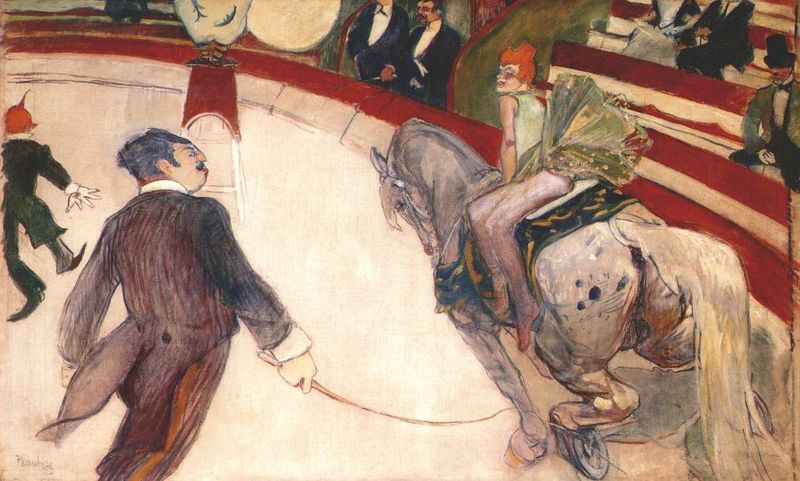
Toulouse-Lautrec, Le Cirque.
Keep riding: Pocock's Horses; Gerard and Loretta Hausman's The Mythology of Horses; Juliet Clutton-Brock's Horse Power.


