Wednesday, March 28, 2007

1959


When an actor, athlete, artist asks for a date, tell him no-oh-oh-oh

Travis and Bob, Tell Him No.

It's the lamest jealous boyfriends on record. Are they even dating this poor girl? After all, while Travis and Bob desperately warn the girl not to fall for the suave guy's charms, not to take his ring, and, basically, not to sleep with him, they don't seem to offer much in return. Nothing like "'cause I'm the guy who really loves you, baby." Not even a ring of their own. Just gentle nagging and the sort of advice you'd get from a maiden aunt.

Did he tell you that he loved you?
And did you thrill to his charms?
And did you feel much more better
When he held you in his arms?


I think the answer might have been a resounding "YES!!!" from the girl in question.


As Everly Brothers knock-offs go, "Tell Him No" is one of the best. Travis Pritchett and Bob Weaver were both from Jackson, Alabama, and "Tell Him No" was their first single and only hit.

They were signed by Sandy Records, a Mobile label so tiny it operated via a PO box. Sandy's founders were a country singer, John Bozeman, and local DJ Paul Du Bose. They considered Sandy to be the equivalent of the local newspaper--featuring only small, hometown acts, who primarily played either rockabilly or country.

Then "Tell Him No" began hitting wide by spring 1959, forcing Sandy to enter a distribution deal with Dot, and then watch as two copycat records immediately were issued, by the Jackson Brothers on Atlantic and by Dean and Marc on Bullseye. While Travis & Bob's original charted the highest (#8 on the national charts), Dean and Marc's outsold it.

Travis & Bob were courted by the Everlys' manager and publisher Wesley Rose, who was looking for a replacement act--the Everlys were dumping him--but Weaver reportedly distrusted the music industry, refused to sign, and the pair broke up soon afterward. (There's allegedly a complete Travis & Bob LP that was never released.) Pritchett kept on as a solo act, but by the late '60s he was selling insurance.

Recorded at Singing River Studio in Biloxi, Miss., and released in March 1959 as Sandy 1017. On Golden Age of American Rock & Roll Vol. 5.

Monday, March 26, 2007

1959


"my heart longed for him, but my foolish brain cried!"

Lonesome Sundown, Gonna Stick To You Baby.
Lightnin' Slim, Rooster Blues.
Lightnin' Hopkins, Fan It.
Jimmy Reed, Take Out Some Insurance.


Some blues for a Monday morning:

First, here are two swamp blues records from Nashville's Excello, both of which were recorded at Jay D. Miller's studio in Crowley, Louisiana, and featured the regulars who had worked there for much of the '50s.

Lonesome Sundown, a contender for having the greatest blues name ever, was born Cornelius Green, and he first got attention as one of Clifton Chenier's guitarists. From '56 on, Sundown recorded a number of tracks for Excello--"Gonna Stick to You Baby" is his best, all bluster and assurance, anchored by Sundown's guitar and seasoned by Lazy Lester's harmonica.

You know the preacher preach the gospel
He didn't jump and shout
I'll be here
until you put me out


"Gonna Stick to You Baby" was recorded in May 1959 and released as Excello 2163, with Miller's usual gang on backup, including Leroy Washington (g), Merton Thibodeaux (p) and Warren Storm (d). On I'm a Mojo Man.

Lightnin' Slim was born Otis Hicks in 1913. He was from St. Francisville, Louisiana, and after the war he started playing bars in Baton Rouge, sometimes working with Slim Harpo. He recorded for Excello for almost a decade, from the mid-'50s to the mid-'60s, when he moved to Detroit (where he died of cancer in 1974).

"Rooster Blues" is heavy (Kenneth Semple's drums sound like mortars going off), relentless and sung by Slim with a nice dusty tone. Recorded in September '59 and released as Excello 2169, with much the same backing group as the Lonesome Sundown track. On Rooster Blues/Bell Ringer.


One day in January 1959, the blues scholar Samuel Charters got a hotel room in Houston, set up a microphone and tape recorder, and got Lightnin' Hopkins to perform ten tracks that would later become the Folkways LP The Roots of Lightnin' Hopkins. (The story goes that Hopkins did two or three songs and announced he was done, and so Charters had to tell him what an LP was, and that he needed to do another 25 minutes' worth of material. One can only imagine the look Hopkins gave him.)

Hopkins' brand of electric blues had begun losing favor with black audiences by the late '50s, and so, quite savvily, Hopkins recast himself as a "folk" musician, going acoustic and finding an eager new audience of college students and various musical purists. His transformation worked marvels--at one point in the early '70s, Hopkins played a command performance for Queen Elizabeth II. I don't think the gloriously dirty blues "Fan It" was on the set list that night.

Recorded on January 16, 1959; on The Very Best.

Jimmy Reed didn't think much of "Take Out Some Insurance," in great part because he didn't write it, but it's one of his finer recordings, sung wryly by Reed (who at the time was turning up on stage viciously drunk, which in turn was exacerbating his epilepsy); it has the sort of easy groove you could get swallowed up in.

Recorded in Chicago on March 26, 1959, and released a month later as Vee-Jay 314. With Lefty Bates (g), Eddie Taylor (b) and Earl Phillips (d). On Boss Man.

Wednesday, March 21, 2007

1959


The Browns, The Three Bells.

"Les Trois Cloches," a chanson written by Jean Villard Gilles during the last days of Vichy France, and made eternal by Edith Piaf, is transformed some years later by a trio from Pine Bluff, Arkansas; in their version, Jim Ed Brown recounts his birth, his marriage and his death, serenaded into the void by his two sisters. Call it folk music.

Released as RCA 7555 c/w "Heaven Fell Last Night"; On Classic Country, though if you'd like to hear everything the Browns ever recorded, here's the set for you.

Monday, March 19, 2007

1959


Titus Turner, We Told You Not To Marry.
Odea Matthews, Five Long Years For One Man.


All the girls on the block wondered: why did Johnny marry Bonnie? Johnny was popular enough at school, though maybe he laughed too loudly, but he went completely off his head for the first girl to really look at him. Bonnie was short and had slightly buck teeth--the line was that she had a "great personality." Still, one day in March, Bonnie and Johnny, their parents, their sullen younger siblings, a few bewildered friends and a minister stood together in an overheated room at the Knights of Columbus.

So it was no surprise that Bonnie had a baby seven months later. They were living in a one-room apartment two streets away from Bonnie's parents, and the new TV and the crib took up most of the living room. Johnny was working at the A&P, and at night he started bartending. No one really saw him any more--all you could hope for was to catch him on a break, and when you did, he just rattled on about the baby or how his car was doing. He was 19 years old and looked spent out.

One rainy morning, Johnny had the day off from work, and said he was going to get the tires changed on the Chevy. That was the last Bonnie ever saw of him.

Some of his friends got letters, his parents got cards. Johnny had gone out to California, and was doing all right there, at one point selling cars in San Bernardino. After a few years, Bonnie stopped thinking that he was coming back. She thought about telling the kid that his father was dead, and once thought about saying Johnny had died in Vietnam, but realized the times wouldn't match up.

But the kid never showed much interest, sensing that even the mere suggestion of Johnny made his mother flinch. He seemed content to let his father be a vague rumor. Bonnie got a divorce, using Johnny's embarrassed parents as intermediaries, and eventually married a guy who had graduated two years before her, and who had hired Johnny at the A&P back then.

One spring afternoon in 1985, at the Vince Lombardi rest stop on the New Jersey Turnpike, a young man in a jean jacket was kneeling to help steer his daughter, who had just started to walk, towards the Roy Rogers counter, when a man well into his forties, wearing a dumpy red sweatshirt that made him look older, nearly collided with them. Johnny apologized to his son, who had looked up at him annoyed, and then cut away, heading back to his car.


Titus Turner was best known as a songwriter--he had written "Leave My Kitten Alone" and "All Around the World"--but he had a sporadic career as a performer as well. In 1959, he signed with Glover Records, and his "We Told You Not to Marry" was Glover's rush-job answer record to Lloyd Price's "I'm Gonna Get Married." (Turner was evidently the go-to guy for answering Lloyd Price records--earlier in '59 Turner had made "Return of Stagger Lee" for King.) The Miller Sisters provided backing vocals, and at times seem ready to take over the record completely. Released as Glover 201; on Hy Weiss Presents Old Town Records.

Odea Matthews was a prison inmate whose crime no one remembers; this recording, in which Matthews is working on a sewing machine as she sings, was made in Angola, Louisiana's state prison, sometime in '59. On Angola Prison Worksongs. First heard this one on Tofu Hut ages ago.

Wednesday, March 14, 2007

1959


Theophilus Beckford, Easy Snappin'.
Laurel Aitken, Boogie in My Bones.


Ska's first steps:

Theophilus Beckford recorded "Easy Snappin'" sometime in 1956, but the track didn't get released until three years later. You could call it, as some have, "year zero" for modern Jamaican music. And you can hear, in its birth spasms, the skanking rhythm, Jamaica's pulsebeat.

Beckford was attempting to imitate Rosco Gordon, a bluesman who made a number of great, raw records for Sun in the early '50s. Tracks like Gordon's had become hugely popular in postwar Kingston, featured at "sound system" dances, essentially open-air discos at which a DJ played the latest American discs for hours. Wynonie Harris' "Blood Shot Eyes" was played year after year, for example.

By the late '50s, homegrown records had begun to replace Yank imports, in part because the hard R&B records that Jamaicans loved were falling out of fashion in the U.S. (and Jamaican audiences had never taken to rock & roll or electric blues, among other styles).

So at some point in '56, Theophilus Beckford sang and played piano at a session manned by a young DJ named Clement "Sir Coxsone" Dodd. Beckford, imitating Rosco Gordon's piano style, a rolling shuffle that heightened the second and fourth beats of every bar, further emphasized the afterbeat, giving the track its drive and unusual rhythmic sense.

Dodd realized he had something tremendous on his hands, and played the track exclusively at his "Downbeat" Sound System dances for years, much to Beckford's irritation, as Beckford naturally wanted the single released to the general public. When "Easy Snappin'" at last came out in 1959, it hit number one in Jamaica and spent a year and a half on the charts. (And, unsurprisingly, Beckford never got a dime in royalties.)

Beckford, who kept performing and recording as ska gave way to reggae in the '60s and '70s, was murdered in Kingston in 2001, slain by a hatchet blow to the back of the head.

"Easy Snappin'" featured Rolando Alphonso (ts), Rico Rodriguez (tb), Cluett Johnson (b), Ken Richards (g) and Ian Pearson (d). Recorded at Federal Studios in Kingston and released as a Worldisc 7" single; on It's Ska Time.


Laurel Aitken, born in Cuba in 1927, had moved to Jamaica by the late '30s. Aitken began as a calypso singer, working the Kingston docks and getting by singing for tourists. In 1957, he began recording R&B records for a small label called Caribou, and attracted the attention of a British expatriate named Chris Blackwell, who was looking to record local Jamaican music.

"Boogie In My Bones"/"Little Sheila" was the first-ever single issued by Blackwell's label, which would become Island Records, and was reportedly recorded after hours in the Radio Jamaica studios and using primarily white Canadian backing musicians. Rosco Gordon was again a primary influence, as Aitken's singing was modeled on Gordon's phrasing.

"Boogie" is far less radical than "Easy Snappin'"--the off-beat is less pronounced, and the feel is much like an early '50s American R&B record, while the sax and guitar solos are far more polished than those in "Easy Snappin'"--but for Jamaican audiences, it was exactly the type of record that they couldn't get from the U.S. any longer, and it became a huge hit.

In the early '60s, Aitken relocated again, moving to the UK, where he became ska's greatest ambassador, and a major cultural presence in the expat Jamaican community. He died of a heart attack in Leicester in 2005.

"Boogie" was initially released as R & B GRC 5935-A in October 1959 and later released on Starlite in the UK. On Ska's the Limit. Both tracks are also found on the box set Tougher than Tough, the greatest overall ska/reggae compilation ever made, and which inexplicably has gone out of print.

PS--After a long time, the links section has been overhauled. Some newcomers, and some longtime faves that I never included for some reason or other, have been added, while most sites that hadn't been updated since last spring or summer got the hook. (If anyone was unjustly booted, please let me know.)

Monday, March 12, 2007

1959


Cannonball Adderley Quintet, You Got It!
Modern Jazz Quartet, Odds Against Tomorrow.


Throughout October 1959, the Cannonball Adderley Quintet was in residency at a club called the Jazz Workshop, in the North Beach district of San Francisco. One night Dmitri Shostakovich, looking to hear for the first time "authentic American jazz," walked into the club and sat with his entourage for an hour, listening to the quintet. He said nothing, but sometimes clubgoers saw him smiling, and during a Louis Hayes drum solo Shostakovich leaned forward at his table, as if drawn to the stage by sheer magnetism.

Shostakovich wasn’t the only one -- on the weekends in particular, the crowds for the Adderley Quintet were such that you couldn’t physically get into the club unless someone else left, and so people stood in the street, blocking traffic, trying to hear the band.

Julian "Cannonball" Adderley had spent much of 1957 through 1959 playing in the Miles Davis Sextet until he left to form his own group, which consisted of his brother, Nat Adderley, on cornet, Bobby Timmons on piano, Sam Jones on bass and Hayes on drums. Observing Davis, with whom he recorded such records as Milestones and Kind of Blue, Adderley had increased the use of space in his performances, and narrowed the scope of his solos while deepening their intensity. In Cannonball's composition “You Got It!” rhythmic drive and ambition (the way Hayes seems to be a beat away from veering off into his own world) is matched by solos that, while still intricate, seem to be striving more for emotional resonance than sheer exuberance. (Nat Adderley's cornet solo in particular.) Night after night at the Jazz Workshop, the entire club would be stomping along with the beat.

Recorded at the Jazz Workshop in San Francisco on October 18-20, 1959. On the essential In San Francisco.


A world away, the Modern Jazz Quartet was making music for bad dreams. "Odds Against Tomorrow," written by John Lewis as part of his score for the Robert Wise film of the same title (a strange late noir starring Harry Belafonte), is the MJQ at its most austere, haunting and sublime.

Many of the MJQ's tracks could be described as extended conversations between Lewis on piano and Milt Jackson on vibes, and "Odds" begins with Lewis ruminating, repeating the same figures over and over again, while Jackson bends notes, as if he means to interrogate Lewis, or muse along with him. (As Gary Giddins wrote, Jackson began his career as a singer, and there's a haunting vocal sound to his vibes playing in this performance.) Percy Heath on bass and Connie Kay on drums testify quietly. The whole piece is a crystalline marvel.

Recorded October 9, 1959; on the film's soundtrack.

Wednesday, March 07, 2007

1959


Irma Thomas, (You Can Have My Husband But Please) Don't Mess With My Man.

Meet Ms. Irma Thomas, who has one thing to say to you ladies: do what you want with her deadbeat husband, but leave her lover alone.

The money my husband made was for red beans and rice
But my man keeps me in steaks, now ain't that nice?


Thomas, born in 1941 in Ponchatoula, Louisiana, knew something about husbands--she had had two before she was 19 years old, and four kids to boot. As a teenager, she had sung in a gospel quartet at the Home Mission Baptist Church, and was working as a waitress in a New Orleans club when bandleader Tommy Ridgley discovered her. Soon, she was singing regularly with Ridgley's band, which led to her being fired from her waitressing job.

"Don't Mess With My Man" was Thomas' first recording, a powerhouse single for the newly-founded New Orleans label Ron. Ron and its sister label, Ric, were both owned by Joe Ruffino--these labels, along with the just-formed Minit, represented a new wave of New Orleans indies that would produce some of the heaviest, rhythm-saturated and most purely enjoyable records of the allegedly "fallow" 1959-63 period.

Recorded in late '59, released as Ron 328 c/w "Set Me Free," and charted in early 1960; on the aptly-titled We Got a Party.

Monday, March 05, 2007

1959


Don French, Lonely Saturday Night.
Don French, Goldilocks.


As ominous as it is ridiculous, Don French's "Lonely Saturday Night" captures a certain aspect of adolescence--the belief that a temporary bout of misery is somehow eternal.

The singer doesn't have a date for Saturday night, as the girl he likes stood him up. But as the song goes on, he moves from desperation to panic to, eventually, near-hysteria, with French's (at-times comically) deep vocal countered by dry guitar and minimal bass. The track goes full-tilt berserk in the bridge, when French, after writhing with jealousy upon seeing happy couples walking by, envisions his female counterpart, just as miserable as he is, but separated from him. Forever!

But don't worry too much--the b-side, "Goldilocks," finds French hanging down on the docks, back in the game.

French demonstrates the limits of half-hearted research: all I managed to find is this site, which has him born in 1940 in Media, Penn. (which I'll take as fact, for why would you make up the place of birth for an obscure '50s pop singer?). French apparently made only two singles--"Saturday Night/"Goldilocks" and the latter's possible sequel "Little Blonde Girl." And then down the memory drain he goes.

Released in March 1959 as Lancer 104. "Saturday Night" is on Golden Age of American Rock and Roll Vol. 4; "Goldilocks" is on Solid Stroll Vol. 2.

Tuesday, February 27, 2007

1959


Buddy Holly, Learning the Game.
Buddy Holly, Peggy Sue Got Married.
Buddy Holly, Love is Strange.
Buddy Holly, Dearest.
Buddy Holly, Slippin' and Slidin'.


The newly-married couple moved into 3B at the Brevoort in the fall of 1958, just as the sycamores were turning. They were very polite whenever you came across them in the hallway. The girl, Maria Elena, is Puerto Rican. While at first she seems shy, she's actually a lifelong New Yorker, and has a quiet confidence in the way she carries herself, as well as an operatic laugh. Her husband, Buddy, is a skinny guy with thick black-framed glasses--when he speaks, you hear Texas.

Their one-bedroom apartment seems relatively modest for someone who, as the neighbors realize, is involved in show business in some fashion. Buddy's often carrying a guitar case. His gawkiness seems to rule against him being any sort of entertainer, though perhaps he's a songwriter up at the Brill, or maybe he produces Frankie Avalon records. Few people at the Brevoort listen to the pop radio stations, and of those, even fewer would have associated Buddy with songs like "Oh Boy!" or "Maybe Baby," which the DJs say are by a band called the Crickets.


The Brevoort, on Fifth Ave. between 8th and 9th, is a huge, bright-new building, only four years old. It seems to radiate cleanness and modernity. The heat pipes work without clanking, the water's always hot when you want it to be. It stands on the grave of the former Brevoort Hotel, once home to a Who's Who of American Reds and bohemians--Emma Goldman, Eugene O'Neill, Isadora Duncan. Longtime New Yorkers complain that replacing the legendary Brevoort with some gruesome middle-class apartments is another sign New York's losing its soul.

In December, Buddy seems between jobs, as he's hanging around the apartment more often. In the mornings, when Maria goes out to the store, Buddy sits on the couch, tunes his guitar and starts running through some new songs. He had last been in the studio two months before, when he had recorded "True Love Ways" and "It Doesn't Matter Anymore." He had been used to Norman Petty's hole-in-the-wall studio in New Mexico, the band doing take after manic take until they got it. At the Coral Record Studios, it was as layered as a wedding cake. Buddy had sung in a vocal booth, then sat on a folding chair in the control room as the row of engineers punched up the string section. He had heard his voice rise and fall, buoyed by tenor saxophone, chased by descending violas. Dick Jacobs, the producer, had smoked through half a pack of cigarettes and simply nodded his head when he thought the mix was done.

It had been only five years since Buddy and his best friend Bob Montgomery had been playing country songs around Texas. Now it sometimes feels like he's leaving country, and even rock & roll behind him, leaving it back in Texas with his old band, his old producer. There's a new sound now--softer, more arranged, soundtracks for imaginary movies. Buddy pinches the strings on his guitar, makes a chord; he imagines Tony Bennett, or Dean Martin even, singing one of his songs.


He's been writing a bunch lately. Some are wistful, like "Learning the Game." When Maria gets back from the store, he plays them for her, and when he thinks one's good enough, he turns on the tape recorder and commits the song to the reels of its memory. Sometimes he and Maria walk across Washington Square Park to her aunt's house, where there's a piano. He plays his songs while the two women smile, drinking tea. They clap when he finishes, and he guffaws.

One morning, whiling away a few hours, Buddy gets the idea to do a sequel to "Peggy Sue," in which Peggy gets married, the way everyone seems to do when they turn 20 or so. He dashes it out quickly, using the same riff as the earlier song--it's half a joke, but there's a sense of loss, a feeling of something ending, in the performance he commits to tape.


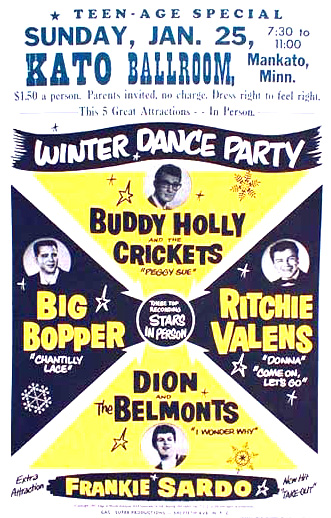
Early in the new year, things are tight. Buddy's split from his former manager has tied up all his money. Buddy's on the phone all the time, looking for some quick work. By mid-January it's arranged. Buddy will head a tour of the Upper Midwest with the Bopper, Dion and Ritchie Valens. Small snowbound towns, hardly any days off between shows, but it'll pay enough.

In the last days before the tour, Buddy keeps recording. He takes Little Richard's "Slippin' and Slidin" and digs into it, extends it, taking pleasure in the changes, in the rhymes, in lines like "she's a solid sender." He breaks the words down, popping consonants, twisting vowels as he works through the song.

And he turns Mickey and Sylvia's "Love is Strange," that pair's sassy, knowing duet, into something as dewily innocent as his own "Everyday." "Dearest," a Mickey and Sylvia b-side, he hushes to sleep, lowering his voice to its depths. One line he sings like a hymn: Our love will grow old...mmm, yeah...our love will grow old.


One shatteringly cold morning, Buddy's in the lobby with a suitcase and his guitar, waiting for a cab to take him to Idlewild. He calls Maria after each show. It's lousy. The crowds are fine (in the audience at the Duluth show is an 17-year-old kid from Hibbing), but the transportation is terrible--the bus has no heat most of the time. It's like a tour of Antarctica. It'd be great if they could get a plane once in a while.

The morning of February 3, some people at the Brevoort, reading the News or the Times or the Herald over breakfast, notice a small AP story tucked away on an inner page. Buddy is dead; a plane lies in pieces on a frozen Iowa field.


Neighbors see if Maria Elena's around, to offer condolences, to be awkward in her presence, but she's gone to her aunt's. A man from Buddy's producers comes by the apartment one day to pick up the tapes. He packs them in a small valise and heads up to midtown. Over the next year or so, they'll overdub strings, bass, drums, backing vocals--weighing the tracks down, but making them commercial enough to sell. "Peggy Sue Got Married" even becomes a small hit.

In the late spring of 1959, the realtors start showing around Apt. 3B at the Brevoort.


The "apartment" tapes Buddy Holly made in Dec. 1958-Jan. 1959 are Holly's last recordings, and have never been released unaltered on CD. The overdubbed versions are found on Remember.

The Brevoort
still stands, though I imagine the rent's a bit more these days.

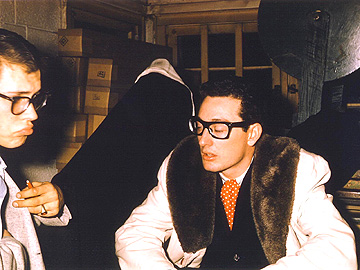
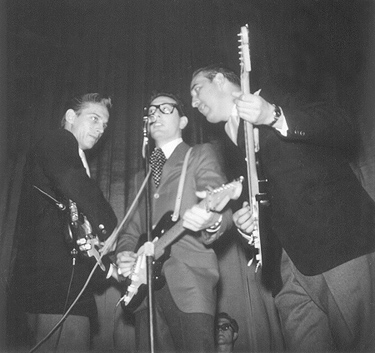
The photos, all of which are from the last days of Buddy Holly's life, are from this amazing resource.

Maria Elena Holly eventually remarried and had children.

Friday, February 23, 2007

Midway


Nel mezzo del cammin di nostra vita
mi ritrovai per una selva oscura,
ché la diritta via era smarrita...

Robert Frost, The Road Not Taken.
The Kinks, Young and Innocent Days.
The Beatles, Help!
Frank Sinatra, Why Try to Change Me Now?
Howlin' Wolf, Getting Old and Grey.
Marvin Gaye, Where Are We Going?
The Kinks, Where Did My Spring Go?


There's a Samuel Beckett story (probably apocryphal) in which Beckett and a friend are walking in London. It's a fine spring day. The friend turns to Beckett: "What a day! Makes one glad to be alive!" And Beckett says, "I wouldn't go that far."

Yeah, it's my birthday today.

Kinks: Arthur and Village Green (spec. ed), respectively; Beatles: here; Sinatra: No One Cares; Wolf: Memphis Days 2; Gaye: Very Best.

Tuesday, February 20, 2007

1958


"she moved in circles, and those circles moved"

Theodore Roethke, I Knew a Woman.
Clyde McPhatter, A Lover's Question.
The Drifters, Drip Drop.
Dwight Pullen, Sunglasses After Dark.
Don and Dewey, Bim Bam.
The Everly Brothers, Down In the Willow Garden.
Jimmy and Johnny, I Can't Find the Door Knob.
The Kalin Twins, When.
Bob Denton with Eddie Cochran, Thinkin' About You.
Dorothy Masuka, Five Bells.
Mel Torme, Body and Soul.
Hylo Brown and the Timberliners, I'll Be All Smiles Tonight.
The Monotones, Book of Love.
Solven Whistlers, Something New in Africa.
Oscar McLollie and Jeanette Baker, Hey Girl, Hey Boy.
Warren Miller, Everybody's Got a Baby But Me.
The Olympics, Western Movies.
Duke Ellington with Mahalia Jackson, Come Sunday (Black, Brown and Beige Pt. IV).
The Elegants, Little Star.
Jerry Butler and the Impressions, For Your Precious Love.


So let's finish off 1958, starting with Theodore Roethke intoning like Zeus in a nostalgiac mood.

Clyde McPhatter, the former lead singer of the Drifters, had left the group back in 1955, but had had only middling luck with charting singles on his own. McPhatter singles were top choice for white performers looking to make a quick remake, which sometimes led to confusion among record buyers and affected McPhatter's sales. Finally, in 1958, McPhatter got a Top 10 pop hit with Brook Benton's "A Lover's Question," an utterly exquisite piece of music whose central question--does the person I love truly love me?--seems unanswerable, at age 17 or 56. This is one of my favorite songs, ever, for what it's worth.

In 1971, after a decade in the wilderness, McPhatter wound up in an R&B revival at the Academy of Music in New York, stuck in an opening slot. "I used to be a headliner, baby," he told the indifferent audience. A year later, he was dead at age 38.

Recorded in New York on August 7, 1958, with Milt Hinton, King Curtis and arrangement by Ray Ellis; released in September as Atlantic 1199. On Deep Sea Ball.

As for McPhatter's former band, here's "Drip Drop," which is a last blast of pure R&B greatness from the "old" Drifters, a year before "There Goes My Baby" and Ben E. King transformed them. This transitory incarnation of the Drifters was headed by lead singer Bobby Hendricks and featured Jimmy Oliver, Gerhart Thrasher, Jimmy Millender and Tommy Evans.

Recorded on April 28, 1958 and released as Atlantic 1187, where it was thrown away as the b-side of the band's take on "Moonlight Bay." On Let the Boogie Woogie Roll.

Dwight Pullen
was born in Alabama, but in his short life he lived all over the place--California, Alaska, Oregon. A year after releasing "Sunglasses After Dark," Pullen became Gene Vincent's road manager; two years later, Pullen was dead of cancer at 31. Released as Carlton 455 in March 1958; on Rockin' From Coast to Coast.


Dewey Terry and Don Bowman were high-school friends from Pasadena, playing in a band called the Squires. Terry also worked after school at a cut-rate record processing plant owned by one Larry Mead, who also happened to run some local record labels. Soon enough, the Squires began releasing singles on Mead labels like Dig This Record and Mambo.

Terry and Bowman left the Squires around the time they graduated high school in 1956, and as a duo wound up on Specialty Records. "Bim Bam" is a typical single of theirs from this period: it's rock & roll refined down to its essential elements. While Don and Dewey didn't have any hits, cover versions of their material often scored--Dale and Grace had a #1 with "I'm Leaving It (All) Up to You," the Olympics took "Big Boy Pete," Jerry Reed had a country hit with "Ko-Ko Joe," and "Farmer John" became a garage rock standard in the '60s.

In the '60s, Terry and Bowman backed Little Richard (in a band that included a young Jimi Hendrix), and also were a lounge act for a time, playing at the Dunes. Bowman eventually renamed himself Don "Sugarcane" Harris and became a blues violinist, playing with Frank Zappa and the '80s punk blues band Tupelo Chain Sex; Terry kept on as a session guitarist and ran a small trucking company on the side. Bowman died in 1999, Terry in 2003.

"Bim Bam" was released as Specialty 631; on Jungle Hop.


You could consider the Everly Brothers' take on "Down in the Willow Garden" a horrific remake of "Wake Up Little Susie." As in "Susie," the lovers go out on a date and the girl falls asleep, but this time the singer poisons his girl with tainted burgundy wine, stabs her with a saber, then throws her body into the river.

I'm not sure what teenagers who got Songs Our Daddy Taught Us, an LP released for Christmas '58, made of a record consisting mainly of murder ballads and lamentations on old age and death. In any case, "Willow Garden" is a gorgeously sung ballad, one that establishes the Everlys as the true heirs to the Blue Sky Boys and the Delmore Brothers.

Recorded on August 16, 1958; on Songs Our Daddy Taught Us.

Jimmy Lee Fautheree, born in Smackover, Arkansas in 1934, teamed up with Johnny Mathis (no, not him--this was "Country" Johnny Mathis) in the early '50s and the pair got attention at the Louisiana Hayride in Shreveport. But Mathis quit the group in 1955 and Fautheree's brother, Lynn, had to subsitute as "Johnny" for gigs. Mathis returned for some studio-only duets with Fautheree, one of which, the ripping rockabilly novelty "I Can't Find the Door Knob," was released as D 1004 in June 1958 c/w "Keep Telling Me." On If You Don't Somebody Else Will.

The Kalin Twins were Herbie and Hal, born in Port Jervis, NY, in 1934. When Herbie was drafted into the Air Force in the early '50s, the twins kept in touch by recording songs on a tape recorder and sending tapes back and forth. "When" was their only hit, especially in the UK, where it sold two million copies. As happens, though, the twins never got anywhere near the charts again, and stopped recording by the early 1960s. Hal was killed in a traffic accident in August 2005, and his brother died of cancer eleven months later.

"When" was released in August 1958 as Decca 30642 c/w "Three O'Clock Thrill"; on When. The Kalins ran a website until their deaths, which included an excerpt of an autobiography which, to my knowledge, was never published.


Eddie Cochran, while recording "Summertime Blues" and C'mon Everybody" in the course of five months in '58, also remained in high demand as a session guitarist (working with everyone from Gene Vincent to John Ashley and the Voices of Allah). Here he is on Bob Denton's "Thinkin' About You," a goofy country-pop track in which Cochran provides a riff so sharp and infectious that it steals the song away from the amiable Denton. Recorded in late '58 in Hollywood, released as Crest 1086. On Cruisin' the Drive In.

Dorothy Masuka, one of the great South African jazz/pop singers of the postwar years, shows how it's done with "Five Bells." Masuka would be exiled from South Africa a few years later for singing about the assassinated Congolese prime minister Patrice Lumumba. On The Grande Dame of African Music.


Mel Tormé, son of Russian Jews who settled in Chicago (the name was originally Torma), precocious vaudeville singer and drummer, struggling film actor, and who once backed up Chico Marx on stage, had spent most of the '50s trying to keep above water. While of the same generation as Sinatra and Bennett, Tormé got few breaks (the great exception being his and Robert Wells' composition "The Christmas Song," which became a holiday perennial). Sometimes he didn't have a record contract, and he had to perform in Australia and Europe to support himself during lean years. But in '58 Tormé was signed by Verve, where he recorded eight LPs over the next few years. While not big sellers, the records were well received by critics and jazz musicians.

Tormé's take on the ultimate jazz standard "Body and Soul," from his first Verve sessions, highlights his quiet artistry: listen to the way his voice dances above Marty Paich's arrangement, a sort of Baroque cool jazz. Recorded in Los Angeles on June 27, 1958; on Tormé.

Hylo Brown
, born in River, Kentucky in 1922 as Frank Brown Jr., got his nickname due to his vocal range. In the mid-'50s he was touring with Flatt and Scruggs, and formed a subsdiary group of sorts, the Timberliners--the two bands would routinely swap touring schedules and TV appearances. In 1958, Brown and the Timberliners recorded a self-titled LP that is generally considered to be one of the best bluegrass albums in history.

"I'll Be All Smiles Tonight," a 19th Century ballad by one T.B. Ransom, had been covered by everyone from the Carter Family to the Louvin Brothers. Brown's version is built around two intricate duets--Red Rector's mandolin and Tater Tate's fiddle, and Brown's tenor and Rector's baritone.

Recorded in Nashville on August 10, 1958, also with Jim Smoak (banjo) and Joe Phillips (bass). Find on Best of Vol. 2.

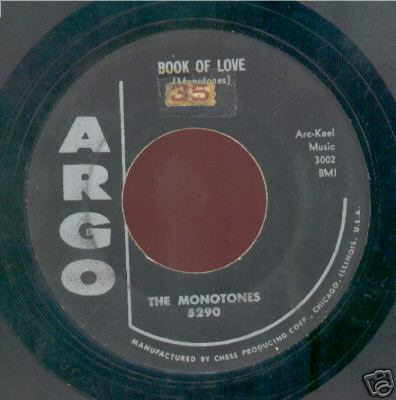
And who wrote the book of love? The Monotones never disclosed. As Greil Marcus wrote in Stranded, "Book of Love" is "the ultimate one-shot. Single of singles." Released in February 1958 as Argo 5920. On Doo Wop Uptempo.


South Africa's The Solven Whistlers were headed by Spokes Mashiyane, a pennywhistle player who helped establish kwela as the country's most popular dance music. "Something New in Africa" comes as a curtain raiser to 1960, when 17 African nations achieved independence. On The History of Township Music.

Oscar McLollie was an R&B journeyman based out of Los Angeles, and had spent much of the decade hopping around labels (including Mercury, Excelsior and Modern) and trying all sorts of styles--Christmas novelties ("God Gave Us Christmas"), regional novelties ("All the Oil in Texas"), rock & roll ("Red Hot Rod Roll"), classy Nat King Cole-esque pop ("Pagliacci (With a Broken Heart)") and yet more novelties ("Take Your Shoes Off Pop").

Finally, in 1958, McLollie was given a singing parter, Jeanette Baker, at the behest of Class Records owner Leon Rene. McLollie and Baker hated each other on sight, but managed to record a one-off duet, "Hey Girl," which neatly stole from the Kendall Sisters' "Yea Yea" and Fats Domino's "La La." It was a solid hit, and McLollie went back to the studio to record a follow-up, only to find Rene had procured another partner for him: a woman known only as Annette. "We recorded together and then I never saw her again," McLollie said years later. Released as Class 228; find on The Golden Age of American Rock & Roll Vol. 8.


World Cup '58: world meets Pelé

Warren Miller was born in Philadelphia in 1937 and only released three singles in his life. "Everybody's Got a Baby But Me" is his first. For cash-in rockabilly funded by UAR, a label that United Artists had just rolled out to flog its film soundtracks, this is still pretty hot stuff. Released as UA-104X in February 1958. Find on That'll Flat Git It! Vol. 12.

The Olympics were founded by former gospel singer Walter Ward, and featured tenor Charles Fizer, who was shot to death by National Guardsmen during the Watts riots in '65. The greatest of their hits,"Western Movies," an ancestor to Public Enemy's "She Watch Channel Zero," was released in May 1958 as Demon 1508, c/w "Well!". On 25 All Time Novelty Hits.

Duke Ellington first performed his "Black, Brown and Beige" suite ("a tone parallel to the history of the American Negro," as he called it) in 1943, to mixed response. He shelved the work for a decade or more, then reinvented in it the studio, with Mahalia Jackson adding the weight of the world. Recorded February 11-12, 1958, in Los Angeles; on Black, Brown and Beige.


The Elegants, from Staten Island, took their name from a bottle of Schenley's whiskey ("Elegance"), stole "Little Star" from Mozart, and were never heard from again after they charted with the single. An American success story, in miniature. Released in July 1958 as APT 25005 c/w "Getting Dizzy"; on Doo Wop Uptempo.

And at last, here's the mighty "For Your Precious Love," a cornerstone of soul, one of the finest vocal records of its era, pure secular gospel.

Jerry Butler and Curtis Mayfield had started out with the Chicago-based Northern Jubilee Gospel Singers, but by 1957 they were singing R&B, in a band called the Roosters, which included three recent arrivals from Tennessee--Sam Gooden and brothers Arthur and Richard Brooks. Vi Muszynski, a songwriter and aspiring record label owner, recorded some demos with the Roosters near the Cabrini Green housing project, where some of them lived.

"For Your Precious Love" came out of these sessions, and was taken up by Vee-Jay, which distributed the record and in the process changed the Roosters' name to the Impressions. Released as Falcon/Abner 1013. Find here.


Films of 1958


Vertigo.
Touch of Evil. The opening shot.
Popiól i Diament (Ashes and Diamonds). "The end of the war isn't the end of our fight."
Kakushi-toride no san-akunin (The Hidden Fortress).
Man of the West.
The Horse's Mouth. Constable: "Have you just sent a telephone message of a threatening character to Mr. Hickson of Portland Place?" Gulley Jimson: "I only said I'd burn his house down and cut his liver out." Constable: "Now he doesn't want to prosecute, but if you go on making a nuisance of yourself, well, he's gonna have to take steps."
King Creole. For me, the best Elvis movie by a mile, in which Elvis has to choose between Carolyn Jones, who later played Morticia Addams, and Dolores Hart, who later became a nun. And his performance of "Trouble" is about as defining a moment as he ever had.
The Tarnished Angels.
Gunman's Walk.
Horror of Dracula. When Mr. Cushing met Mr. Lee.
Separate Tables.
The Big Country.
Fiend Without a Face.
The Sheepman.
Thunder Road. I know it's late, but we can make it if we run.

Wednesday, February 14, 2007

1958


Sun Ra and His Arkestra, Saturn.

One would have needed either fanatical dedication or just blind luck to have actually heard this track in the year of its release--Jazz in Silhouette, the Sun Ra LP that contains "Saturn," was pressed on cheap vinyl, issued in handmade covers, and sold only in a few Midwestern record stores and by the generally-broke members of the Arkestra for cash after gigs. The LP was at last officially released by Impulse in 1975, but even then distribution was spotty and sales were miniscule.

It's a shame, as it's one of Sun Ra's most accessible records. "Saturn" in particular is an amazing track, looking ahead to free jazz while keeping one foot in bebop, even R&B. It opens with Ra's six-beat exorcism on piano, then a wild 14-bar introduction that shifts and lunges all over the place (more than two octaves, according to Ekkehard Jost). Then, as if a projectionist has changed reels, a danceable, even slightly corny main theme emerges, with John Gilmore on tenor sax and Pat Patrick on baritone sax delivering a sweet pair of solos. Consider the whole piece swing music for the first moon colony.

Sun Ra was born Herman "Sonny" Blount in Birmingham, Ala., in 1914. The odd story of Blount's life can't be reduced a few sentences of biography. Even Blount's Birmingham childhood home was bizarre, as Robert Campbell relates: In a Southern city that was heavily segregated by race, the Blounts did not live in either a black neighborhood or a white neighborhood. Theirs was the only house on an entire city block. They were located across the street from the Post Office and close to the main railroad station. As a child, Sonny could look out the window and see the big sign over the railroad tracks that greeted visitors to The Magic City; many years later that would become the title of one of his greatest (and most avant-garde) compositions. To the north, there were just open fields.

"Saturn" was recorded at "El Saturn Studio" (i.e., someone's basement or rehearsal room) in Chicago, with Pat Patrick (bari sax), Marshall Allen (alto sax), John Gilmore (tenor sax), Charles Davis (bari sax), James Spaulding (alto sax. flute), Julian Priester (tb), Hobart Dotson (t), Ronnie Boykens (b) and William Cochran (d).

Next week: we wrap up '58. In style, as always. Plus, I get a year older.

Monday, February 12, 2007

1958


The Jamies, Summertime, Summertime.


The Jamies were a quartet from the Boston neighborhood of Dorchester (one of the guys has a honker of an accent): siblings Tom and Serena Jameson, Jeannie Ray and Arthur Blair. "Summertime, Summertime" was their one-hit wonder. Has any song better captured the joy of the first day after school's ended, with nothing but an endless length of sun-blessed days stretching out before you?

I love the glorious ramshackle nature of this track--the way everyone singing seems on the verge of going flat, or the zinging harpsichord, which sounds like the Jamies' dotty great-aunt is accompanying them, or the way Serena has to cram in an overlong line (so it sounds like "cos whatsa sum'vacation without romance" and you can hear her stumble midway through, poor kid).

There's one line that's always puzzled me: "It's time to head straight for the mills." As a kid, when first hearing this song, I thought of a bunch of teenagers being shipped off to work at a textile factory or something, which seemed a cruel betrayal of the song's philosophy. But what are they singing? The most common, quite logical theory has it that the Jamies are actually singing "It's time to head straight for them hills." The dark horse theory, however, ventured by one crank on Usenet back in the day, was that the Jamies were singing about heading for "The Mills"--a reference to "Dorchester Mills," an alleged hot beach spot somewhere in the Boston area. The main flaw with this theory is that I've never run across any other reference to the so-called "Dorchester Mills" in my life.

(Boston anecdote: I once saw some kids, maybe 10 or 11 years old, walking along Commonwealth Avenue, near Kenmore Square. They were a bit rough, like a 1990 version of the Dead End Kids. One of them hurled a huge plastic Coke cup on the sidewalk behind him. His friend, seeing this, yelled at him: "Hey, this isn't Dorchester!")

While "Summertime" was initially released as Epic 9281 in September 1958 (how cruel to put this track out just as school was resuming), it was reissued four years later. On 25 All-Time Greatest Summer Songs.

Wednesday, February 07, 2007

1958


The Coasters, Yakety Yak.
The Silhouettes, Get a Job.
The Miracles, Got a Job.


In which teenagers declare war on the adult world. While skirmishes out in the brush continue to this day, the kids eventually seized control, though they still had to get jobs at some point.

The Coasters' "Yakety Yak" was recorded in New York on March 17, 1958, with King Curtis on the sax break and Mike Stoller (who wrote the song with Jerry Leiber) as arranger and pianist. It was released as Atco 6116 c/w "Zing! Went the Strings of My Heart," and was played in the home of every adolescent in America: find here.

The Silhouettes
were once a gospel group known as the The Gospel Tornados, but their masterpiece, "Get a Job," dealt with secular time: first released in late '57 as Junior 391, the single went national early the next year as Ember 1029: find on Doo Wop Uptempo. The Miracles' answer record "Got a Job," the first appearance of an ambitious young singer named William "Smokey" Robinson, and the first composition by an equally ambitious producer named Berry Gordy, was rushed out in March 1958 as End 1016: find on Ooo Baby Baby.

Monday, February 05, 2007

1958


Rod Bernard, Pardon Mr. Gordon.
Rod Bernard, This Should Go On Forever.


You might not be able to guess from listening to the tracks, but Rod Bernard was a Cajun. Born in Opelusas, Louisiana, in 1940, Bernard was playing guitar and singing professionally by the time he was 10 years old, first in a group called the Blue Room Gang and, after Bernard had heard Elvis, with a rock & roll band called the Twisters.

"This Should Go On Forever" was Bernard's moment in the sun: a national pop hit, leading to appearances on American Bandstand (where Dick Clark asked Bernard to rewrite the song's best lines, "If it's sin to really love you/then a sinner I will be" so as not to offend teenagers) and tours with Frankie Avalon and Chuck Berry.

However, I've always loved the other side of the single far more. That's where you'll find "Pardon Mr. Gordon," which follows in the grand tradition of songs sung by men who acknowledge they're going to get thrashed by a bigger, meaner guy if they don't get out of the way. (Descendents include Lynyrd Skynyrd's "Gimme Three Steps.")

And is it just me, or does the sped-up Alvin and the Chipmunks-esque line really sound like Bernard's saying "Shut the fuck up"? Maybe it's just me.

Released as Jin 105, and later in 1959 as Argo 5327. On Essential Collection.
Click here to see Gordon lip-synching "This Should Go On Forever" on American Bandstand, April 1959.

Wednesday, January 31, 2007

1958


Jimmy Smith, The Sermon.

"Anyone who plays the organ is a direct descendant of Jimmy Smith. It's like Adam and Eve -- you always remind someone of Jimmy Smith," Joey DeFrancesco.

One of the deacons of soul jazz (essentially, jazz heavily under the influence of gospel and blues) was an organist named Jimmy Smith. Smith, born in Norristown, Pennsylvania, in 1925, started out playing the piano and the string bass, but by the mid-1950s, he had found his true instrument: the Hammond B-3 organ. Earlier incarnations of the Hammond organ dated back to the 1930s--the Hammond had been designed to be a replacement for the pipe organ, as well as an updating of the traditional upright piano which used to be a staple of most middle-class homes.

(Cultural devolution, in miniature: My grandmother kept a piano and, later, an organ, in her home; her children, at times, owned elaborate stereo systems; and her grandchildren and great-grandchildren (with the exception of a few oddballs, like those who run MP3 blogs) typically make do with tiny metal or plastic speakers attached to iPods or CD players.)


The Hammond B-3 was, to some purists, a vulgar instrument, best suited for the skating rink or movie intermissions; the B-3 was loud (thanks to the Leslie speaker), its tone was often distorted, and it was capable of generating a host of ridiculous noises. Yet the Hammond fit in perfectly with a resurgence of a smoother, simpler, more melodic type of jazz, along with the return of "dueling tenor" contests, in which saxophone players attempted to outdo each other with loud, flashy solos. By the late 1960s, the sound of the Hammond had become essentially a jazz cliche.

But Smith, when he began playing the Hammond B-3 in a trio with a pianist and drummer, exploited the organ to its limits, making it groan, wheeze, hiss, titter. And to do so, he extended compositions to elaborate lengths--forty solo choruses for "Sweet Georgia Brown," for instance. He played quadrupedally: on the Hammond's twin keyboards, his left hand provided chords, his right soloed, while, via the pedals, his left foot slammed out bass lines, and his right foot controlled the organ's volume.

When Smith found worthy partners, the result would be a sort of soulful hypnosis--long performances built around a rolling, dense groove, over which players would slowly, deliberately offer their own advices. A prime example is Smith's masterpiece, the twenty-minute "Sermon."

It begins with Smith and Art Blakey establishing the groove (Smith, via the Hammond, is providing the bass lines as well). Then comes Kenny Burrell on electric guitar, Tina Brooks on tenor sax (who stays the longest), Lee Morgan on trumpet (who starts out sparring and never relents), and Lou Donaldson on alto sax.

Recorded at Manhattan Towers, NYC, on February 25, 1958; on the essential The Sermon! Because of its length, the track had to be imported at a low bit rate to fit on my server, and so it sounds pretty dire.

The top photo is, of course, Art Kane's "Harlem 1958." Clicking on the photo should make it a bit larger. Try to find Dizzy Gillespie, Mary Lou Williams, Thelonious Monk, Ben Webster, Henry "Red" Allen, Sonny Rollins, Lester Young. (A sobering thought: all the boys sitting on the curb are likely in their sixties now.) All is revealed here.

Monday, January 29, 2007

1958


The Collins Kids, Whistle Bait.
The Collins Kids, Rock Boppin' Baby.


Let's begin with 14-year old Larry Collins, who, while sounding as though he's yet to attain puberty, is evidently randy enough to leer and hoot at some poor girl on the street. "She's-a whistle bait!!" he squeaks in this freakish little voice which Morpheus could have used to overdub nightmares. That said, Larry could play guitar like a madman--that neat solo on the double-necked Mosrite is all his.

And on the flip side, his 16-year old sister, Lorrie, sings about her talented boyfriend.

The Collins Kids were from Pretty Water, Oklahoma, and in a story that seems written by MGM hacks, the Collins family literally sold the farm and moved to Hollywood in the hopes their two children would become famous. The Collins Kids appeared on an LA TV station's country music show in 1954, and, aided by the publicity generated when Lorrie began dating Ricky Nelson, soon made it to national shows like Steve Allen and Ed Sullivan.

You need to see this utterly fantastic performance of the Kids performing "Rockaway Rock," in which Tex Ritter adds some truly half-hearted backing vocals.

The Collins' stopped recording by the early '60s, though Larry went on to write a number of country standards (like "Delta Dawn"), while Lorrie, at age 17, married Johnny Cash's manager.

Released in August 1958 as Columbia 4-41225. Find on Rockin'est.

Friday, January 26, 2007

1958


their rockin' homework is what they love the best

Gene Summers and His Rebels, School of Rock 'N Roll.

Where Chuck Berry's "School Day" is a precise sketch of the tedium of a typical American high school, whether it's the Class of 1958 or 2007, Gene Summers' "School of Rock 'N Roll" is pure greaser fantasy, the kind of place where the only use for books is to steady a wobbling amplifier.

Summers was born in Dallas in 1939, and the Rebels (originally called the Dixie Rebels) consisted of Summers' classmates at Arlington State College--James McClung (lead guitar) and Gary Moon (drums)--along with bassist Bonny Williams, a kid who the Rebels liberated from Thomas Jefferson High School.

As awesome as "School of Rock 'N Roll" is, Summers, while sharing the stage with nearly every major rock & roll act during the late 1950s, never had a national hit.

Released c/w "Straight Skirt" in March 1958 as Jan 11-100. On Ultimate School of Rock & Roll.

Happy weekend.

Wednesday, January 24, 2007

1958


Benny Goodman, Goodbye.
Ornette Coleman, The Sphinx.


Gordon Jenkins' "Goodbye" had become, by the late 1930s, the standard closing number for the Benny Goodman Orchestra. Goodman had taken to the piece quickly, often investing a sorrowful tone to the lead clarinet melody. And during the war, "Goodbye" naturally became a poignant end to an evening.

Goodman had experimented a bit with his sound in the postwar years; at times he seemed to be attempting a sort of chamber bebop. Yet by the mid-'50s, there's a sense that Goodman has resigned himself, quite comfortably, to becoming a representative of a waning age.

This version of "Goodbye," recorded in the American Pavilion at the World's Fair in Brussels, in May 1958, is not Goodman's farewell performance by any means--he would continue to play regularly throughout the following twenty years, and lived until 1986. But there is a sense of summation, of departure, to this recording: it's a sweet valedictory, a farewell to the swing era, performed with grace and beauty.

With Sheldon Powell and Zoot Sims (tenor sax), Gene Allen (bari sax), Al Block and Ernie Mauro (alto sax), Billy Hodges, John Frosk, Taft Jordan and E.V. Perry (trumpets), Roland Hanna (p), Billy Bauer (g), Arvell Shaw (b) and Roy Burns (d). On Benny in Brussels.


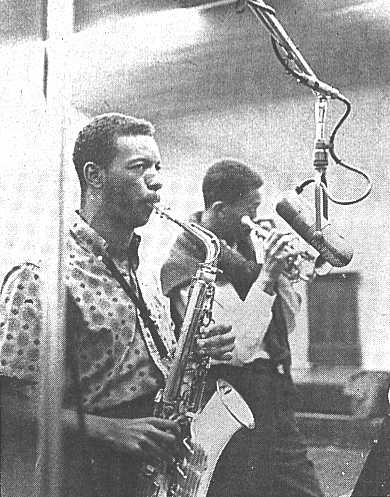
Two months earlier, in Los Angeles, Ornette Coleman, a 28-year-old alto sax player born in Ft. Worth, Texas, began what would be his first recording sessions as a leader. The whole thing had come about almost as a whim of Contemporary Records' owner Lester Koenig. The bassist Red Mitchell had told Koenig about some raw kid playing around LA, using toy instruments (Coleman played a white plastic alto saxophone, while his trumpeter, Don Cherry, played a Depression-era "pocket" cornet.) While Coleman's live performances were controversial, to put it mildly, Mitchell said his original compositions were worth hearing.

So Koenig arranged an audition for Coleman, hoping mainly to determine if he could pass Coleman's original pieces on to more established musicians. Coleman and Cherry showed up, but Coleman, flustered, found he couldn't play his compositions on piano. So in desperation, he and Cherry delivered the tunes on their horns. Koenig, fascinated, arranged for a full band session.

"The Sphinx" comes from the tail end of the sessions for what became Coleman's first LP. Like the rest of the tracks on Something Else!!!!, it's a relatively conventional performance, though Coleman and Cherry are sharp and vivid, their solos burgeoning with fresh melodic ideas and suggesting a volcanic reservoir of talent. The following year would feature the first of Coleman's epochal Atlantic LPs, The Shape of Jazz to Come, and his legendary performances at the Five Spot in New York. So consider this a curtain raiser.

Recorded in Los Angeles on March 24, 1958, with Walter Norris (p) Don Payne (b) and Billy Higgins (d). On Something Else!!!!

Monday, January 22, 2007

1958


Paul Perryman, Satellite Fever Asiatic Flu.

Strange as it may seem now, this was a topical song, referring to the resurgence of the "Asiatic Flu," which had first appeared in Russia during the last years of the 19th Century. The 1957 pandemic began in China early in the year and had spread to the United States by the summer. (Shoghi Effendi, leader of the Bahá'í faith, died from it, along with possibly a million others worldwide.) The outbreak, and the subsequent mass vaccination campaign, already had inspired songs like Ebe Sneezer and His Epidemics' "Asiatic Flu," whose lyrics included the immortal couplet "You know what I think about this here disease/Give it back to the Asians and let them (sneeze sound)!"

Add in some hysteria about the Russians' launch of Sputnik, and the potential for nuclear war via outer space, and you've got the raw material for a gloriously insane rock & roll attack, featuring an inspired, vulgar, squalling sax break.

(And it goes without saying that the whole thing is a pretty transparent rewrite of Huey "Piano" Smith's "Rockin' Pneumonia and the Boogie Woogie Flu" from the previous year.)

Of Paul Perryman I know absolutely nothing, except that he released a few other singles for Duke in 1957 and 1958, the most notable being "Just to Hold My Hand," soon covered by Clyde McPhatter. Perryman may have been from Alabama, and some have speculated he was a protege of Duke's owner Don Robey, but who knows. The man exists now as a name on a few half-century-old 45s. Still, with a track as great as "Satellite Fever," that's achievement enough.

Released as Duke 181 c/w "I'm Walking Out." The only place to find it on disc is apparently the out-of-print Pittsburgh's Favorite Oldies, Vol. 6.