Tuesday, May 31, 2005

1951


Lee Konitz (w/Miles Davis), Hi-Beck.
Miles Davis, Down.


Here we find Davis at his most protean, tinkering with cool jazz in the studio, establishing the rules of hard bop on the stage.

Lee Konitz's "Hi-Beck" is pure distilled cool, beginning with an airy musing by Konitz on alto sax. When Davis finally enters (1:50 in), his 32-bar solo is rarefied, light and sparkling. The whole performance is a quiet essay in perfection, a Debussy etude retrofitted for the jet age.

Konitz, born in 1927, was one of the few saxophone players who came of age in the 1940s who did not slavishly attempt to imitate Charlie Parker. Rather, Konitz took his cues from Lester Young and Benny Carter, and his compositions were greatly influenced by his mentor, the blind pianist Lennie Tristano.

Konitz, who had been part of the Davis Nonet and contributed to the "Birth of the Cool" sessions, reunited with Davis for a four-side recording session, one of the few times Davis ever recorded as a sideman, and the only time he did so for the Prestige label.

Yet as brilliant as Davis is on "Hi-Beck", his eyes were looking elsewhere. Three months later, Davis would be on the stage at Birdland with a dizzy collection of young players desperate to establish themselves, and the music they created was loud, unrelenting and confident.

"Down", a Davis composition, is fierce from the start, driven by Art Blakey's aggressive drumming. Davis' opening solo is nothing like his restrained contribution to "Hi-Beck"--after a slow start, Davis grows in speed, complexity and intensity until he seems to be sparring with the band, trying to throw off Blakey's tempo. After Davis comes the 20-year old Sonny Rollins, the great bop trombonist J.J. Johnson, and pianist Kenny Drew, who cools it down a bit.

"Hi-Beck" was recorded in New York on March 8, 1951, with Sal Mosca (p), Billy Bauer (g), Arnold Fishkin (b) and Max Roach (d). Available on Palo Alto, a nice collection of Konitz's 1949-1953 recordings.

"Down" is from a June 2, 1951 Birdland concert best found on the just-issued Complete Birdland Recordings, from Definitive Records.

Friday, May 27, 2005

1951


soft drinks all around

Johnny Bond, Sick, Sober and Sorry.
Martha Carson, Satisfied.


Johnny Bond's waltzing with sin, and while in the bleary hangover-cursed morning he seems a bit regretful, he's likely going to do it all over again tonight. Hopefully he'll miss the cops this time.

Bond, who came from Oklahoma, started out as part of Gene Autry's organization, working on Western films and co-starring on Autry's radio shows. Though songs like "Sick Sober" were country hits, Bond was known more as a songwriter, penning standards like "Cimarron" and "I Wonder Where You Are Tonight." He died in 1978.

"Sick, Sober and Sorry" was recorded in Hollywood on March 13, 1951, with Tex Atchison (fiddle), Jimmy Bryant (lead gtr), Speedy West (steel), Paul Sells (p), Bert Dodson (b), and Eddie Forrest (d). Released as Columbia 20808, and hit #7. It's on Legends of Honky Tonk.

Martha Carson
was reeling from a bitter divorce from James Carson Roberts, her former musical partner, when, driving to a gig with Bill Carlisle one day, the thought came to her that if she was satisfied with herself, God ought to be satisfied with her. She took one of Carlisle's blank checks and wrote out the lyrics on the back.

Carson, who died last December, was the Rockin' Queen of Happy Spirituals, touring with Elvis Presley when he was still an unknown, and teaching him a few things about stage presence.

"Satisfied," an exuberant mix of black gospel and white country spiritual, was a smash. Recorded on November 5, 1951, in Nashville, with Chet Atkins on lead guitar, Martha Carson on rhythm, Ernie Newton (b), Marvin Hughes (p) and the likes of Carlisle, Sally Holmes and Jean Chapel on vocals. It's on a host of cut-rate gospel compilations, like this one.

Happy weekend.

Wednesday, May 25, 2005

1951


A brighter cleaner world


Thelonious Monk, Criss Cross.

"Compositions like Criss Cross...are pure, un-cluttered musical emanations," Gunther Schuller wrote in 1958. "It is not a "song", a term so many jazz musicians apply to all the music they work with, it is not a "tune"--it is a composition for instruments."

Schuller makes "Criss Cross" sound like a knotty, cerebral chore, but it's really a brilliantly constructed chutes-and-ladders game, in which Monk conscripts rhythm to work as melody. So many twists: Monk, in his four-bar intro, offers a rising melodic pattern that is answered later by a downward slide; the strange six-bar bridge (first appearance at 0:25), that forces the players to jump each time it ends; the way Monk, in his later solo, starts assembling the pieces of the original theme before the band resumes it.

The first solo goes to vibraphonist Milt Jackson (who received co-billing on some early releases). Jackson, who would soon co-found the Modern Jazz Quartet, was Lionel Hampton's only rival on the vibes--a wonderfully subtle, moody player. After him, Sahib Shihab offers a nice, conventional (only in comparison to Monk's brilliant oddities) meditation on alto sax. Al McKibbon's jaunty bass and Art Blakey's drumming make it all swing.

Recorded on July 23, 1951, in WOR Studios, New York. On The Genius of Modern Music, Volume Two.

Criss-Cross on paper.


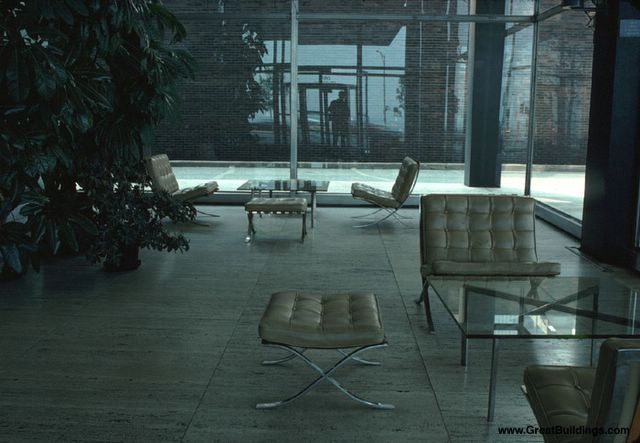
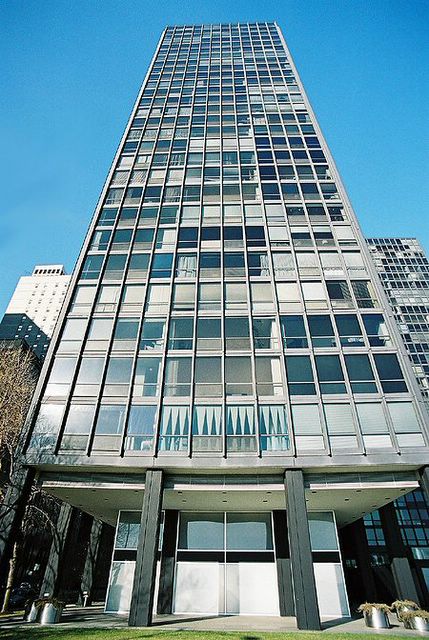
The cold dawn of the glass houses. Top image: lobby of Ludwig Mies van der Rohe's Lake Shore Drive apartments in Chicago, completed in 1951. The reign of the steel-and-glass boxes, now blighting cities worldwide, begins here.

Monday, May 23, 2005

1951


L.B. Lawson and James Scott Jr., Can't Love Me and My Money Too.
L.B. Lawson and James Scott Jr., Scott's Boogie.
L.B. Lawson and James Scott Jr., Flypaper Boogie.


"To me, a lot of the early stuff that I recorded--the Blues--could be classified as masterpieces. With the jet age coming on, with cottonpicker machines as big as a building going down the road...I knew that this music wasn't going to be available in the pure sense forever," Sam Phillips, 1984.

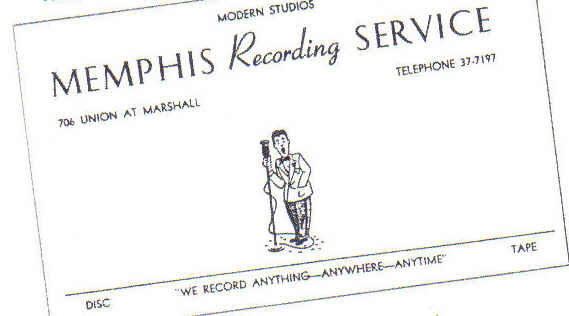
In January 1950, a 27 year-old disc jockey and amateur recording engineer named Sam Phillips opened the Memphis Recording Service, on 706 Union Avenue. His plan was to record local blues and country artists and to sell the sides to independent labels, and he soon established relationships with the Los Angeles-based Bihari brothers, who owned Modern Records and RPM, and Chicago's Chess brothers, who were gearing up their self-named label.

Phillips was convinced that rawer-sounding country and blues (which at mid-century were still sold primarily to rural white and black markets, respectively) could reach a wider audience. It would take him four years until he found his passport in the form of a young man who, at the time Phillips began recording, was idling his hours away at Humes High School. But in his search, Phillips recorded many blues players at the peak of their powers, and began documenting on acetates the gestation process of rock and roll.

Phillips soon gained a reputation with blues artists as someone who treated them fairly, with respect, and who made no attempt to sweeten their sound. "I tried to get them to record what they had, and to bring out of them what they were," he would tell Martin Hawkins decades later. "This is difficult for me to explain, but I felt it so strongly it was almost a religious belief."


At some point in 1951, a group of local musicians known as the Scott Jr. Blues Rockers went into 706 Union and recorded four sides that stayed in the Sun vaults for 35 years. These records, which apparently even Phillips thought were too raw for release, are a lost founding document of rock & roll: it's the sound of the Rolling Stones' Exile on Main Street, but two decades earlier--basement music; Satanic juke joint blues filled with insistent rhythms. Music as an accidental conspiracy--the two guitars, James Scott's lead and Charles McLellan's rhythm, scrap and tear at each other, Robert Fox's drums thrash along behind them.

"Can't Love Me" is a standard blues overturned by its performers. Scott's vicious lead guitar kicks it off, and then L.B. Lawson reels into the first verse, sounding a bit drunk, giving way in turn to a boogie break in which McLellan fuels the rhythm, as the drummer is shuffling around by himself in the corner. Lawson stumbles back in. "Tell me babe, what's a matter with you last night?" he slurs at his woman. "We had to hurry home 'cos you know we got to fight." And the guitars spar off.

"Flypaper Boogie" and "Scott's Boogie" are even more astonishing. In "Scott's Boogie," Scott is spiralling around until he catches the rhythm McLellan is brewing. About forty seconds in, the guitarists seem to have completely dispensed with the drums, which are again just murmuring in the background; McLellan drives the beat and Scott dances on it. "Flypaper Boogie" goes deep into a primal blues state, where Scott strings out brutal, simple lead lines while McLellan hovers on the beat until he starts coming after Scott in a locomotive attack. Both tracks end quickly and sloppily, with a clatter, as if the players suddenly have lost interest.

Who were these men? Lawson is a historical cipher, about whom almost nothing is known, not even what his initials stood for. One site lists him as being born in 1929, relying on unknown sources; he possibly came from Enid, Mississippi. The fourth track the group recorded at Sun (much inferior to the others) was "Got My Call Card," which suggests Lawson, if he wrote the lyrics, was about to be drafted into the Korean War. He never recorded again, to the best of my knowledge, and is apparently dead.

The record is a bit clearer on Scott. Born in Adabina, Mississippi in 1913 (or 1923), and an alleged classmate of John Lee Hooker, Scott formed the Blues Rockers in 1948. After the Lawson session, Scott appears to have worked as a journeyman blues guitarist throughout the 1950s and 1960s, backing Boyd Gilmore, among others. He died in 1983.

Most of these tracks cannot be purchased at present (though "Flypaper Boogie" is available on this compilation), so consider this post a public incentive--someone really needs to put the Lawson/Scott sides out, and do more investigative work than this paltry effort. The tracks were first released on the colossal Sun Records: The Blues Years, a 9-LP box set issued in 1986. A decade later, the UK's Charly Records updated the set to CD, including more unreleased tracks--thus making the set even more invaluable, and naturally it soon went out of print. Much of this post's information is derived from the Charly set's booklet, written by Martin Hawkins, Colin Escott, Neil Slaven and Roger Dopson.

Friday, May 20, 2005

1951


"been so long, the carpet has faded on the floor"

Sonny Boy Williamson (II), Mighty Long Time.

In which we present the triumph of guile and age over wasted youth.

Imagine if an older rock musician, someone born in the '50s and who has been playing for decades, began recording under the name Kurt Cobain, releasing albums that, in time, people would confuse with those of the original Kurt Cobain, and that ultimately would dwarf the original Cobain's records in terms of influence.

It happened in the blues. Aleck "Rice" Miller, aka Sonny Boy Williamson II, was born in 1899, fifteen years before John Lee Williamson, the original Sonny Boy Williamson, whose name Miller would appropriate. It's unclear when Miller started using the "Sonny Boy" name, but the first Williamson's murder in 1948 cleared the way for Miller's assumption. (You could call it a blues papal name.)

Miller had been an itinerant musician in the South throughout the 1930s and 1940s, and gained regional attention by playing harp and singing on "King Biscuit Time," a radio program based out of Helena, Arkansas. Levon Helm, recounting his youth: "If it was a Saturday afternoon, everybody knew that I was downtown with the good people of Marvell, Arkansas watching Sonny Boy and his King Biscuit Entertainers performing outdoors on a makeshift stage."

In 1951, Sonny Boy Williamson II began recording for Trumpet, an independent label started up by Lillian McMurry. "Mighty Long Time", the highlight of these early sessions, features an eerie repeating vocal bass figure (by Cliff Givens) supporting a duel between Williamson's astonishing harp playing and his voice.

Released as Trumpet 166, b/w "Nine Below Zero," in April 1951. All of Williamson's great Trumpet sides are collected on Arhoolie's King Biscuit Time.

Wednesday, May 18, 2005

1951


Audrey H. meets the world

Billie Holiday, Detour Ahead.

"Detour Ahead" is one of Holiday's overlooked masterpieces, in part because it is a weird footnote in her career--it was one of four tracks she recorded for the Aladdin label (which mainly issued R&B records), with backing by Tiny Grimes' Sextet, which were rarely anthologized.

Holiday's singing on "Detour" is nonpareil, as she takes the at-times goofy driving metaphors of the lyric and infuses them with slow grace, melancholy and experience. "The further you travel, the harder to unravel," she sings, with the sound of someone already deeply snared in the web.

"Detour" was written by the "Soft Winds" jazz trio of violinist Johnny Frigo, guitarist Herb Ellis and pianist Lou Carter. Holiday recorded it on April 29, 1951 in New York, and it was released as Aladdin 3094 as the B-side of "Be Fair to Me." (The other two Aladdin sides were "Rocky Mountain Blues" and "Blue Turning Grey Over You.") With Grimes on guitar, Heywood Henry (baritone sax) and Bobby Tucker (p). You can find it on the hodgepodge Billie's Blues or the more extensive Ultimate Collection.

Monday, May 16, 2005

1951


"it's a solid beat"

Hank Garland, E String Rag.


The study of a guitar god cut short in his prime. You might be familiar with Hank Garland's session work in the 1950s, as he played lead on Elvis Presley's "Little Sister" and "(Now and Then There's) a Fool Such As I," the Everly Brothers' "Bye Bye Love" and Patsy Cline's "I Fall to Pieces," among a host of other hits. And with Bill Byrd, Garland co-designed the Byrdland guitar in 1955.

But Garland once had ambitions as a solo artist. Born in 1930 in Cowpens, South Carolina, Garland was playing professionally by age 15, first with Paul Howard, a Bob Wills disciple, and then Cowboy Copas. In 1949, Garland signed with Decca and had a quick hit with "Sugarfoot Rag". But due to a host of bad production decisions (i.e., downplaying Garland's hot guitar stylings in favor of rote imitations of Floyd Tillman and Hank Snow songs), most of Garland's records didn't move.

At his best, though, Garland was one of the last broad synthesists in American popular music--the greatest influences on his playing were Maybelle Carter, Arthur "Guitar Boogie" Smith and Django Reinhardt, and he was equally comfortable with and adept at playing pop, country, rock & roll and jazz, when the latter music in particular was severing itself from the pop mainstream. (Garland recorded with a jazz trio on 1960's Jazz Winds from a New Direction.)

"E String Rag" is from Garland's last Decca session. It features his fleet, twanging solos (especially the four-bar one around 2:00--a waggling, vaulting dance of notes), and a sort of proto-"Dance to the Music" bit in which drummer Farris Coursey, bassist Ernest Newton and pianist Owen Bradley all get a little space to introduce themselves.

Recorded on August 31, 1951, at Castle Studio in Nashville, and released as Decca 46382. w/ Jack Shook and Harold Ray Bradley on rhythm guitar and Tommy Jackson on fiddle.

In 1961, Garland was nearly killed in Tennessee when he was thrown from his station wagon when it overturned; after recovering from a coma, Garland discovered that his coordination had been so impaired that he could no longer play the guitar. After enduring a tough few decades, Hank Garland died last December.

You can find "E String Rag" on Hank Garland & His Sugar Footers, a nice compilation of his Decca sides on Bear Family Records. Please visit the Garland family's website.

More on the low 'E' string, and a primer on guitar physics.

top painting: Mark Rothko, Number 12, Untitled (Orange & Red).

Friday, April 29, 2005

NYC: Goodbye


east side, west side, all around the town

Uri Caine, The Sidewalks of New York.
Luna, Going Home.
Lou Reed, NYC Man.
Harry Nilsson, I Guess the Lord Must Be in New York City.


So, it's over--my time here. In an hour or two, the computer goes down and gets packed up, the server will close its doors (hence YouSendit's pinch hitting), and then I prepare for the utter misery of moving house.

I had thought to write something lengthy about leaving New York, the end of youth, etc. etc. etc., but I just don't have the time and I think I've said everything I wanted. So here are four last songs.

"Sidewalks of New York" is a 110 year-old song; this version, performed by the pianist Uri Caine and a large group of conspirators on their 1999 album of the same name, attempts to recreate what it must have been like to sit in a saloon on Delancey Street on a Saturday evening in 1904.

I come from a family of Irish immigrants, some of whom came to New York around this period, and if fancy takes me, I can imagine that some of them, after a day spent on the docks, sat in a bar and heard something similar to this.

"Going Home" is off Luna's 1994 album Bewitched. There is one particular set of lines that, after Sept. 2001, became heartbreaking.

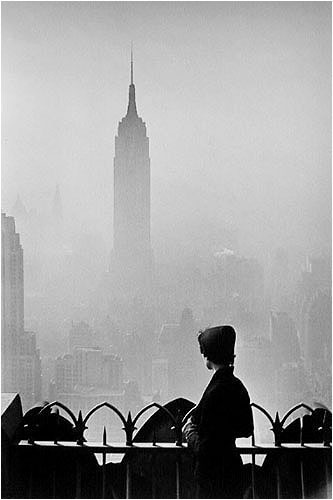
The Chrysler Building was talking
to the Empire State
The Twin Towers were talking
to each other
Saying all is forgiven,
I love you still,
And we're home, home
going home...

I worked in 2 World Trade Center for two years, and in its shadow for three more. Strange that such a statement, which would have seemed innocuous not too long ago, now stamps me with history, as a citizen of the irrevocable past, in the way of someone who was born in East Berlin, or Austria-Hungary.

Finally, two blessings for the city. In Lou Reed's "NYC Man," from 1996's Set the Twilight Reeling, Lou acts like being an NYC man means never saying goodbye, and hitting the road whenever you get the hint you're not wanted, but he's really a bit of a softie. His line at the end-- "New York City, I love you"--is basically what I've been trying to say in two weeks of posts.

And Harry Nilsson is tired of praying and getting no answers, so he's moving to New York to see if the Lord is hanging out there. Best of luck to him. On Personal Best, one of the best anthologies ever released. (If the Lord is in New York City, he's living in Queens or Brooklyn--trust me. He needs the space.)

Hail & farewell, NYC. I'll be back from time to time, and will always be here in spirit. As old Walt says:

"Just as you feel when you look on the river and sky, so I felt,
Just as any of you is one of a living crowd, I was one of a crowd,
Just as you are refresh'd by the gladness of the river and
the bright flow, I was refresh'd,
Just as you stand and lean on the rail, yet hurry with the
swift current, I stood yet was hurried,
Just as you look on the numberless masts of ships and the
thick-stemm'd pipes of steamboats, I look'd."

Walt Whitman, "Crossing Brooklyn Ferry"

Wednesday, April 27, 2005

NYC: East Side/Downtown


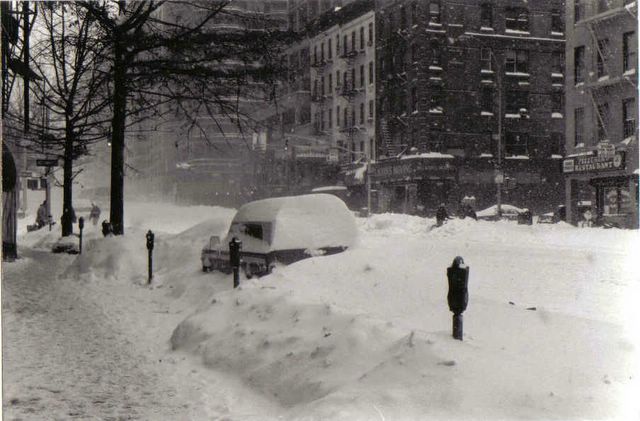
the gruesome winter of 1996, First Ave and 83rd.

The Ramones, 53rd and 3rd.
East River Pipe, Down 42nd Street to the Light.
Rufus Wainwright, 14th Street.
Jake Holmes, Houston Street.
Duke Ellington, Wall Street Wail.


"But at this remove what I think of as
strange and wonderful, strolling the side streets of Manhattan
on an April afternoon, seeing hybrid pear trees in blossom,
a tossing, vertiginous colonnade of foam, up above--
is the white petalfall, the warm snowdrift
of the indigenous wild plum of my childhood.
Nothing stays put. The world is a wheel.
All that we know, that we're
made of, is motion
."

Amy Clampitt, "Nothing Stays Put."

Snowed under by packing, so nothing but basics today.

"53rd and 3rd," the intersection where Dee Dee Ramone allegedly used to turn tricks to score heroin (it's the first stop in Manhattan for the E and F trains, ideal for the Queens-based junkie), is on the Ramones' first (and best, for me) record, released in 1976. It's saddening, and bewildering, that there is only one surviving original Ramone left.

East River Pipe is a one-man operation run by F.M. Cornog, formerly based in Astoria, Queens (where I also lived at the turn of the century). "Down 42nd Street" is off 1999's The Gasoline Age, which documented Cornog's move from Astoria to New Jersey--a song cycle about New York, New Jersey and driving. More Pipe CDs.

"14th Street," a grandiose pop fantasy that bears little resemblance to the grubby retail strip that is 14th Street today, is off Rufus Wainwright's 2003 record, Want One. Rufus' website--his upcoming tour dates.

Jake Holmes wrote two songs that most people have heard of--one is "Dazed and Confused," which Jimmy Page blatantly stole from him; the other is "Be All that You Can Be," the Army recruitment jingle. "Houston Street" is off Holmes' second record, 1968's A Letter to Catherine December, which appears to be available only via import or iTunes. (Note for non-New Yorkers: it's pronounced How-stun Street. Not, as the British guy I used to work with pronounced it, "hwoo-stone.")

"Wall Street Wail" was recorded on Dec. 10, 1929, six weeks after the great stock market crash, and was issued under "The Jungle Band", an Ellington band pseudonym. It's available on the Complete Brunswick Recordings.

On Friday: The End.

Monday, April 25, 2005

NYC: West Side/Uptown


that a mugger and a child should share the same paradise

Bruce Springsteen, Tenth Avenue Freeze-Out.
Nellie McKay, Manhattan Avenue.
Bobby Womack, Across 110th St.
John Coltrane, Central Park West.
The Clash, Broadway.
Charlie Parker Quintet, 52nd Street Theme.


"I could take the Harlem night
and wrap around you,
Take the neon lights and make a crown,
Take the Lenox Avenue busses,
Taxis, subways,
And for your love song tone their rumble down.
Take Harlem's heartbeat,
Make a drumbeat,
Put it on a record, let it whirl,
And while we listen to it play,
Dance with you till day--
Dance with you, my sweet brown Harlem girl."


Langston Hughes, "Juke Box Love Song"


When I was ten years old, "Tenth Avenue Freeze-Out" was my favorite song off Bruce Springsteen's Born to Run, and it still is. It's always sounded to me like Bruce is singing "talkin' bout the Talmud" towards the fade-out.


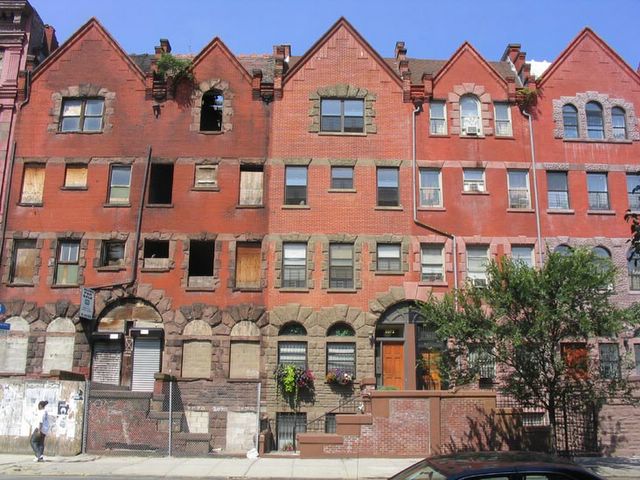
Manhattan Ave. in its youth

Nellie McKay's "Manhattan Avenue" was recorded at the Aldrich Museum in August 2004. The complete set is on McKay's website, and the original studio version is on Get Away from Me, my favorite record from last year. If you gave me a periscope to spy ten years into the future, I would try to scour a record store to see what Nellie had put out.

"Across 110th St." is the theme song to the searing 1972 film of the same name, starring Anthony Quinn and Yaphet Kotto, and later was used to great effect in Quentin Tarantino's Jackie Brown. It was the finest thing Womack, an R&B journeyman, ever did. Get the soundtrack here.


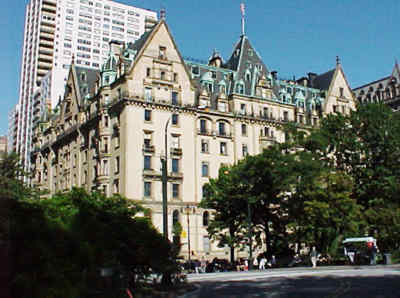
The Dakota, 72nd and Central Park West, home to the Lennon/Onos and Satan.

Coltrane's "Central Park West" was recorded in 1960 and issued four years later on Coltrane's Sound, one of the loveliest, most underrated of Coltrane's Atlantic LPs. "Central Park West" was the first time Coltrane played the soprano saxophone on record--here he keeps to the horn's lower register for much of the performance.


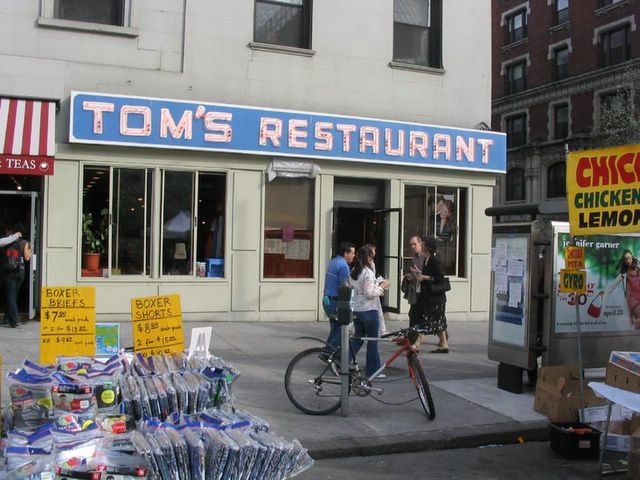
Tom's Restaurant, 112th and Broadway, aka "The Seinfeld restaurant," and where Suzanne Vega read in the newspaper that William Holden had died--he was no one she had heard of.

"Broadway" is on the Clash's 3-LP epic Sandinista!, released in late 1980. It's a bloated, sprawling, indulgent mess of a record, but one in which I find buried riches every time I listen to it. Once we were driving late at night down an emptied avenue, most likely Second, and the lights went in our favor, and there seemed to be no other cars at all, not even taxis, and so we went something like forty blocks, at breakneck speed, without ever touching the brake, and it felt as though we could have sailed all the way down to Battery Park. "Broadway" came on, and it was perfect: "Forward!...Drive!...Green lights! Green lights!"


Parker's "52nd Street Theme" (written by Thelonious Monk) was recorded at the Royal Roost on September 4, 1948, with an intro by Symphony Sid that unfortunately cuts into Bird's opening solo. It's on the Genius of Charlie Parker.

(Due to server issues, these last two are available via "yousendit"--not ideal, but the alternative was to compress them to the point of being unlistenable.)

Friday, April 22, 2005

NYC: Solitude, Despair, Anomie


I can't give it away on Seventh Avenue

Bill Hicks, New York Apartment.
Bob Dylan, Hard Times in New York Town.
George Gaynes, et al, What a Waste.
The Trade Winds, New York's a Lonely Town.
Grandmaster Flash & the Furious Five, New York, New York.
Pamela Myers, Another Hundred People.
The Rolling Stones, Shattered.


"Now I do know that I am mad
For here are a million people surly with traffic..."

Ezra Pound, "N.Y."

It can beat you down, living here. It's expensive, it's soul-wearying. And good God, it gets crowded. There are times (most recently for me, when I made the mistake of wandering into the pedestrian- and car-choked hell that is Herald Square on a warm Sunday afternoon) when the sheer mass of people crammed into this city makes you want to dive off a pier and swim across the Hudson.

And "edginess," catnip for adolescents, eventually gets old. I'll miss a lot of things about this town, but someone standing on my corner yelling "I've got a knife!" is not one of them.

New York can be a wonderful place to be alone, but it can also be merciless and crushing when you are blue. That said, the city will always give you perspective if you wait long enough; it will provide vistas into far deeper trenches of misery. One day I was walking down Broadway feeling quite low, until I saw a man kneeling on the sidewalk, crying and slamming his fists on the pavement.

Best street shakedown: summer 1996. I was walking in Murray Hill when a nicely dressed guy with impeccably styled dreads came up to me and gave me this story. He had been working on the new Lou Reed video when he was told he had to go up to Stamford to get some equipment. And as it turned out, he'd left his wallet at his girlfriend's place in Brooklyn, and all he needed was a few bucks to get a Metro North ticket, so could you help me out man, you look like a cool guy, etc. etc. It's the classic hustle story that makes absolutely no sense if you think about it, so the con has to keep talking fast enough so that you don't have time to. I was so impressed by the details of the con (a Lou Reed video? Stamford?) that I wound up giving him $5.

Here are seven slices of New York desperation:

Everyone who's ever lived in New York (except for those lucky few who nab those legendary rent-controlled two-bedrooms) can empathize with Bill Hicks' apartment woes. Hicks, one of the finest, most caustic comedians in recent memory, died ridiculously young at 32 in 1994. From Love, Laughter and Truth, a collection of previously-unreleased Hicks material.

Bob Dylan recorded "Hard Times" in a friend's apartment in December 1961, on a return trip to Minneapolis after spending close to a year in New York. The melody and much of the lyric is taken from the folk standard "Down on Penny's Farm." Times really weren't that hard for Bob--by this point, he had already recorded his first record and had played Carnegie Chapter Hall. After being bootlegged for decades, "Hard Times" was officially released on The Bootleg Series: Vol 1-3.

"What a Waste," which ought to be required listening for all kids planning to come to New York to make it big, is from the 1953 musical Wonderful Town, written by Betty Comden, Alfred Green (lyrics) and Leonard Bernstein (music). Sung by George Gaynes, Warren Gajour and Albert Linville. Original cast recording here. The Cape Cod singer's story is the saddest, for me.

The Trade Winds actually were New Yorkers, but they weren't surfers. The duo was Peter Andreoli and Vincent Poncia, a pair of Brill Building songwriters officially known as "Anders and Poncia" (check the Mystical Beast's archives for much more information on the later work of A&P). "New York's a Lonely Town," a great Beach Boys pastiche released in 1964, was their biggest hit. You can find it on the sublime collection Surfin' Hits. (Poncia would later write a number of '70s pop hits, like Leo Sayer's "You Make Me Feel Like Dancin'".)

Grandmaster Flash & the Furious Five's "New York, New York", a harsh sequel to the already grim "The Message", was released on Sugar Hill Records in 1983. DJ Grandmaster Flash, Melle Mel, Scorpio, Cowboy, Kid Creole and Raheim were the first great rap group, whose influence seems almost immeasurable today. Soon after "New York" was released, the group fell apart due to legal battles. You can find "New York" on Adventures on the Wheels of Steel, an incredibly essential 3-CD compilation. (I had to compress the hell out of this song to make it fit on the server, so the sound is pretty poor, unfortunately.)

"Another Hundred People" is from Stephen Sondheim's Company, a 1970 musical that, despite some datedness (call answering services, "swinging" stewardesses), is still a fairly accurate and biting look at loneliness and marriage in upper-class NYC. Original cast recording here.

"Shattered" is on 1978's Some Girls, the last great Rolling Stones album.

Wednesday, April 20, 2005

NYC: Circulation


the people ride in a hole in the ground

Duke Ellington, Take the "A" Train.
Le Tigre, My My Metrocard.
The Last Poets, On the Subway.
New York Dolls, Subway Train.
Tom Waits, Downtown Train.

"We were very tired, we were very merry---
We had gone back and forth all night on the ferry.
We hailed, "Good morrow, mother!" to a shawl-covered head,
And bought a morning paper, which neither of us read;
And she wept, "God bless you!" for the apples and pears,
And we gave her all our money but our subway fares
."

Edna St. Vincent Millay, "Recuerdo."

Three subway moments:

9 train at South Ferry, evening. A mother and her toddler-age son walk through the doors and, without missing a beat, the mother says, "corner pocket." The kid runs to the small bench across from the conductor's booth and sits down.

N train, near Times Square. It's a quiet midday train, and the conductor starts giving advice over the intercom. "Gentlemen...you know, you don't need a suit and tie...to be a gentleman. If you see a lady standing, why don't you give her your seat? And if you're single, and she is too, well...I can't think of a better way to start a conversation."

4 or 5 train, Brooklyn Bridge. Late at night. A mild-looking middle-aged woman walks into the empty car ahead of me. There's a burning stench in the air. She takes a sharp sniff and turns to me. "It's crack!!" she says.


Five songs about the IRT/IND/BMT:

"Take the A Train," written by Billy Strayhorn (the title came from the directions Ellington gave the young, Pittsburgh-born Strayhorn as to how to get up to Harlem) is Duke Ellington's signature song. Recorded in 1941 by Ellington's all-time greatest group, the "Blanton-Webster" band (Jimmy Blanton played bass, Ben Webster played tenor sax). Available on all sorts of Ellington compilations--none finer than this.

"My My Metrocard" is off Le Tigre's first album, released in 1999. Le Tigre (as of this album) is Kathleen Hanna, Sadie Benning and Johanna Fateman. Visit their website, buy their stuff. For non-New Yorkers: the Metrocard is the plastic yellow card that gets you past the turnstiles--it quickly and quietly killed off the storied subway token in the late 1990s.

The subway has always been the tense racial intersection of New York. "On the Subway" is off the incendiary, amazing first album by the Last Poets, released in 1970. The Poets were David Nelson, Gylan Kain, and Abiodun Oyewole.

Having a set of New York songs without including the Dolls is inconceivable. "Subway Train" is off their first album, produced by Todd Rundgren, released in 1973. I saw David Johansen once, sitting outside a restaurant on Columbus Ave. at midday, looking stunned to be awake so early. Get it here.

And Waits' "Downtown Train" is an obvious but neccessary choice. If for some reason you haven't heard this song before, or are only familiar with the Rod Stewart version, sit down and listen to it a few times. Then get Rain Dogs. Please.

Monday, April 18, 2005

NYC: Attitude


Ace Frehley, New York Groove.
Leadbelly, New York City.
Betty Comden & Adolph Green, New York New York/Lonely Town.
John Lennon, New York City (demo).
Bobby Short, Manhattan.


Buenas noches
Don't mind the roaches

--"Lullaby for New York," Joseph Brodsky.

So, I'm moving.

I've lived in New York City for a dozen years and now I'm saying goodbye to it, heading far up country, to a place where it's going to be so quiet at night I won't able to bloody sleep for months.

For the next two weeks, I'll be offering a bunch of songs that sum up New York for me--the look and feel of the city, its many joys and miseries.


My first proper job in NYC entailed a lot of flying around the country to attend mind-numbing business conferences.

One night in Houston, I was in the airport preparing to board a plane home, after a really awful day. The man checking my ticket barely glanced at it and asked me what my final destination was.

"New York," I said. "I live there."

He looked at me somberly, with a sort of pitying expression that one would give a child who said he had lost a parent, and said, "I am very sorry to hear that."

Just one example of many similar instances. When I say I am from NYC, there's always a chance someone will slag off the place. Is there something inherently wrong with the city? Too noisy? Too full of itself? Too many freaks?

Maybe so. But as I wished I had said to the ticket collector at the time, "But sir, don't you live in Houston?"

So as a corrective for the haters, here are five songs that convey the excitement of coming to New York, whether for the first time or the hundredth.

The sailors in Comden and Green's "New York New York" are ready to tear through the city until their lungs burst. Leadbelly is so excited about New York that he's going back to Georgia and Louisiana and tell everybody about it. John and Yoko love the place even though they're getting harassed on the street. Even Ace Frehley, pulling into town with his groupies, is so impressed that he gets out of his limousine at 3rd and 43rd and staggers off into the night.

And then there's Bobby Short, the king of the Carlyle Hotel, who embodies old Manhattan sophistication. Short seems to have been born here, but he actually came from Danville, Illinois--an immigrant like the rest of us.

"New York Groove" is on Frehley's first solo album, from 1978. At the height of their success, the members of Kiss made the commercially suicidal decision to each release a solo record on the same day. Frehley's is by far the best of the lot. Buy here.

Leadbelly's "New York City", recorded in 1940, can be found on the collection Take This Hammer.

Comden and Green's rendition of their compositions "New York New York" and "Lonely Town" (both from the 1944 musical On the Town) is on the 1955 LP Comden and Green Perform Their Own Songs, available on CD here.

John Lennon's "New York City" demo, recorded in 1971, is on the 4-CD Lennon Anthology; the studio version is on Sometime in New York City, a fascinating mess of an album.

Bobby Short just died this March. His ebullient version of Rodgers and Hart's "Manhattan" is found on this great (and sadly out of print) collection. A live version can be found here.

Thursday, April 14, 2005

1950


Duke Ellington and Billy Strayhorn, Johnny Come Lately.
Duke Ellington and Billy Strayhorn, Tonk.


If you had been lucky to attend a party to which Duke Ellington and his songwriting partner, Billy Strayhorn, had been invited, you might have heard something like these tracks. After a few cocktails, when the party had slowed down, Ellington and Strayhorn would sit together at the piano (if you invited Duke to a party, you'd better have a piano) and play some four-handed duets.

Strayhorn, composer of "Take the A Train", "Chelsea Bridge", and hundreds of other Ellington songs, was for Ellington "the other half of my heartbeat," as Duke put it. The two men had become a joint compositional mind, able to answer each other's improvisational questions the second they were asked. You can hear it in the duets, in which it's almost impossible to determine who is playing what, other than that Ellington often starts the melody and Strayhorn usually plays the sprightlier phrases.

In late 1950, Ellington and Strayhorn recorded eight piano duets--these were completely casual, improvised recordings, produced by Ellington's son Mercer and critic Leonard Feather. Nowhere else was the relationship between Ellington and Strayhorn so wonderfully exemplified.

"Tonk", according to Feather, was a popular party favorite and the only one of the duets that had even the slightest bit of arranging to it. Strayhorn's "Johnny Come Lately", like most of the duets, was recorded spontaneously one day--Ellington and Strayhorn just sat down and played, the tapes rolled.

The Strayhorn/Ellington duets have had a cursed release history. The duets were put out as Mercer Ellington's label's first-ever release, a 10-inch LP, which was soon deleted when the Mercer label went kaput. In the mid '50s, most of the Mercer label's master tapes were consumed in a fire, including those of the duets. In 1964 Riverside, using copies of the original Mercer 10" LP, released all the duets on an LP that would prove to be the label's very last release, and one not widely distributed.

Both "Tonk" and "Johnny Come Lately" were recorded in November 1950, with either Wendell Marshall or Joe Shulman on bass. You can find all the piano duets on Great Times. To be honest, the sound of this CD (remastered in 1989) is tinny and weak. The LP that I took the tracks from, The Golden Duke, (Prestige P-24029), sounds 100 times better--those happy few with turntables can find it secondhand pretty easily.

A lengthy historical intrusion:



At 4 AM on a rainy Sunday morning, 25 June 1950, South Korean troops along the border between North and South Korea were dozing in happy disarray, as many of their officers had taken weekend passes and lay asleep far from the front. And then, at once, in one consecutive sweeping motion, the North Korean army smashed through the 38th Parallel across the waist of the Korean peninsula, demolishing the South Korean army, and within a month controlled all of Korea but for a half-circle around Pusan, in the southeast corner.

The Korean War is one of the 20th Century's most critical and most forgotten wars, now mainly remembered in the U.S., if at all, as the backdrop to the TV series "M.A.S.H." (and in which Korea substituted for Vietnam).

Korea was one of the unfortunate hinges of the postwar world, a place where the tectonic plates of the USSR and the West ground together. Korea had been controlled by Japan from 1905 to 1945, and after the war, was divided between a Soviet-approved dictator in the North and a U.S.-approved dictator in the South. The 38th Parallel, chosen for its latitudinal simplicity as a dividing line between the two new countries, was nowhere as clean on the ground, severing cities, lakes, properties, families.

A historical irony is that at the time of the dismembering of Korea, the North was the country's industrialized section, which had regarded the agricultural South as a grubby backwater. 55 years on, the roles have reversed, to put it mildly.

The first year of the war was complete bedlam. Two days after the invasion, the U.S. (gaining UN approval) pledged to come to the South's defense. In September, Gen. Douglas MacArthur landed troops in Inchon,a port city behind enemy lines, and soon pushed the Northern forces back up to the Chinese border (going far beyond the UN mandate, which simply called for a restoration of the 38th Parallel border).

This overreach was in part due to MacArthur's delusion (shared, or at least condoned, by Truman) that he could remake the entire Korean peninsula into a Western-friendly client state, as he had just done with Japan, and that the Chinese would allow this to happen on their doorstep. So China's decision to send in an army of "volunteers" (also, during the chaos, China decided to invade and annex Tibet) seems all too predictable in hindsight. The Chinese-backed North Koreans (literally--the Chinese would make the Koreans form the front lines and take more casualties) again almost overran the South until Gen. Matthew Ridgway, the finest American commander of the war, managed to push the North Koreans back to roughly the old North/South border. (Civilization owes Ridgway a small debt of thanks--his ability to stabilize South Korea deflated the argument that the U.S. should drop nuclear bombs on Korea and China.)

So by year's end, things stood almost as they had that rainy morning in June, but for the hundreds of thousands of dead and the country now in tatters. This Quicktime map sums up the back-and-forth. (Found on this site.) It would take another three years to end the war.

Total killed: 415,000 South Koreans, 520,000 North Koreans, possibly 900,000 Chinese, roughly 54,250 U.N forces. And an unspecified, horrific number of civilians, possibly as many as four million. Needless to say, the country was nearly annihilated--at least half of Korea's industry was destroyed and one in three homes were leveled. Curtis LeMay: "We eventually burned down every town in North Korea... and some in South Korea too. We even burned down Pusan -- an accident, but we burned it down anyway."

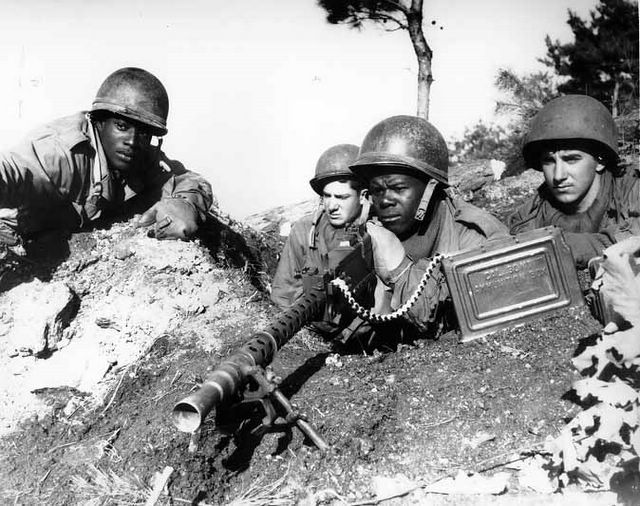
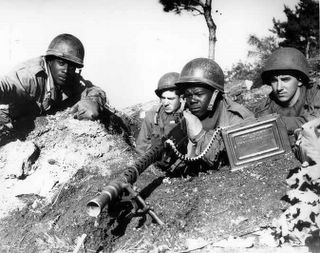
Korea was the first US conflict to feature interracial units. It wasn't an easy transition.

"There was one in particular, Beard. He was just a simple, die hard, worthless redneck peckerwood. I'm telling it like it is. He was just a die hard that would not bend. He was in the Military Highway Patrol and he flipped his car in snow on the highway and he died. All the black soldiers were applauding like crazy. They was walking around chuckalucking beer, and those that didn't drink was chackalucking soda. And I was one of them, cause I was glad to see him gone. But looking back it was a horrible thing to do, because I was only 22 years old then, and as I matured, I realized through reading and going to school that any man's death diminishes me because I am involved in man-kind. I think it was Sir Francis Bacon who wrote that. And I'm sorry, but he was such a pain in the butt."

from "When Black is Burned", an amazing history of black soldiers in Korea.

An oral history of U.S. veterans of the Korean War.


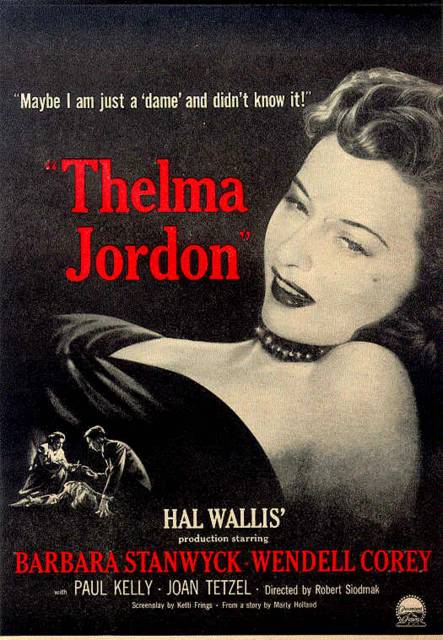
Films of ’50.

In a Lonely Place. Probably Nicholas Ray's best film, which is to say, about as good as it gets. "It was his story against mine, but of course, I told my story better."
Rashômon. By this point, Kurosawa could have filmed the Old Testament and improved upon the original.
Wagon Master. John Ford’s favorite of his films.
The Asphalt Jungle. “Crime is only a left-handed form of human endeavor.” Marilyn Monroe becomes immortal in ten minutes.
Sunset Blvd. A funeral for the golden age of movies, with Buster Keaton and Erich von Stroheim as pallbearers and Gloria Swanson as the deranged widow; a poisoned dagger aimed straight at Hollywood’s spine.
All About Eve. "Tell me this, do they have auditions for television?" "That's all television is, my dear, nothing but auditions."
Panic in the Streets. A thriller whose biological terrorism fears are all too contemporary; the young Jack Palance, a study in cinematic virility, dominates the film without even intending to.
Winchester ’73.
Les Enfants Terribles.
La Ronde.

And that's it for 1950. Look for 1951 to begin sometime in mid-May, whenever I've unpacked enough records.

The next two weeks will feature a bunch of songs united by a theme, and some will be shockingly modern for this site. Hope you enjoy. Starts Monday.

Monday, April 11, 2005

1950


Yma Sumac, Xtabay (Lure of the Unknown Love).

Neither the Incan princess she was marketed as, nor the Brooklyn housewife Amy Camus she was rumored to be, Yma Sumac was, for a brief moment in the early 1950s, the strangest popular singer in the U.S.

She was born Zoila Augusta Emperatriz Chavarri del Castillo in Ichocan, Peru in 1927. In the early 1940s she joined the Compania Peruana de Arte and eventually married the Compania's leader, composer Moises Vivanco. Vivanco and Sumac, along with her cousin, Cholita Rivero, came to New York and performed as the Inca Taqui Trio. Sumac gained attention after a tour of the Borscht belt clubs in the Catskills and some television appearances, and Capitol Records signed her in 1950.

Her first album, a 10-inch LP Voice Of Xtabay (pronounced "shta-bye"), was released in October 1950 and quickly sold half a million copies. One can imagine the PR crew at Capitol sitting around a cigarette- and Scotch-cluttered table one night in Hollywood, conjuring up the ridiculous back story they gave Sumac--that Sumac was a Royal Sun Virgin, a direct descendant of the last Incan emperor Atahualpa, lured away from her ancestral home by anthropologists.


Sumac's voice was extraordinary--she had a four octave (some say five) range, enabling her to imitate Louis Armstrong and shatter a glass in the same breath. The music supporting her, composed by Vivanco and exotica king Les Baxter, was a fusion of Latin rhythms, Peruvian folk music and overripe Hollywood film scores. It was an early indication of a growing public taste in the '50s for bizarre "world" music; and so the reverent borrowings from Eastern music by composers like Messaien would be matched, in popular music, by grand DeLuxe cartoon "exotic" LPs--the sort of things that would gather dust in family rooms over the decades, mocked as ridiculously dated kitsch, until some hipster grandchild rediscovers them.

You can find Xtabay here, and everything from CDs to lobby cards from Sumac's official site.

More on the goddess Xtabay. "Mayan legend states that Xtabay, hidden in the form of a sharp and rigid cactus flower, comes to life when she sees a man pass by. She awaits him under the jungle trees, brushing her long, flowing hair with cactus spines until he is unable to resist her attraction.

Xtabay seduces him and destroys him in a frenzy of infernal love
."

Monument to Xtabay, Mexico.


"Afternoons, when the fossil sea was warm and motionless, and the wine trees stood stiff in the yard, and the little distant Martian bone town was all enclosed, and no one drifted out their doors, you could see Mr. K in his room, reading from a metal book with raised hieroglyphs over which he brushed his hand, as one might play a harp."

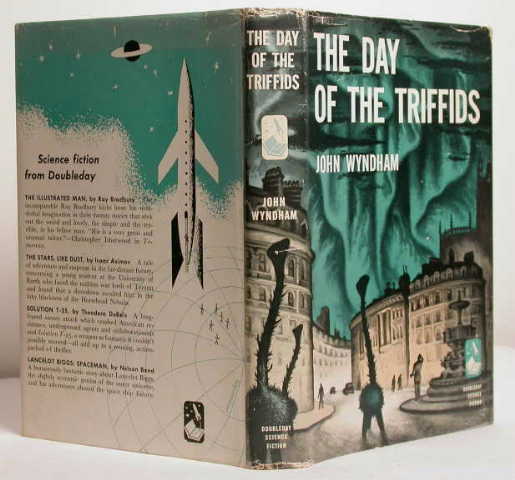
In May 1950, Ray Bradbury's The Martian Chronicles was published, one of the most poetic SF novels ever written, in which Mars is an ever-changing series of mirrors for Earth, ranging from lost faery kingdom to a newly despoiled wilderness to a stage on which the slaughter of the American Indian is reenacted. Some chapters are badly dated, but the book as a whole still has a majesty to it.

Thursday, April 07, 2005

1950


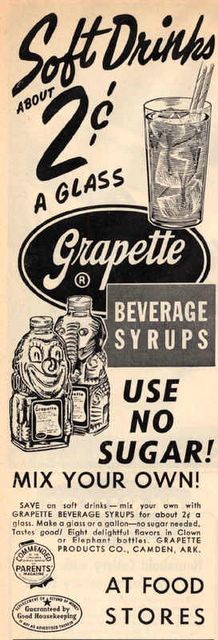
mix your own sugar

Ruth Brown, Teardrops From My Eyes.
Roy Milton, Information Blues.
Smiley Lewis, Dirty People.


A trio of R&B songs, as we start winding down the year.

Ruth Brown, the woman who built Atlantic Records, and one of the godmothers of rock and roll, was born in Portsmouth, Virginia in 1928 and started out singing in USO clubs during the war. Her stint at the Crystal Caverns club in Washington DC attracted Duke Ellington and DJ Willis Conover, the latter of whom called Atlantic co-owner Ahmet Ertegun to rave about her. Ertegun signed Brown in 1949, and after a few middling successes with slower-paced songs like "So Long" and "I'll Get Along Somehow," Brown had her first smash with "Teardrops," which was recorded in September 1950.

It was a monster--holding the #1 slot for almost three months in 1950 and 1951, and it would be the start of a string of hits Brown made for Atlantic during the decade.

"Teardrops" stands on the cusp of rock and roll--Brown's vocal is already there, and Budd Johnson's tenor sax solo is nice and meaty, but there's still a bit of big band stodginess in the arrangement. Still, who's complaining, really?

Roy Milton is, for one. "You can never tell what's on your woman's mind," he notes, while the Solid Senders swing behind him in sympathy. He doesn't know for sure, but his left eye's been twitching and is flesh is crawling--there's another man somewhere; he can almost smell him.

"Information Blues," released as Specialty 349, is state-of-the-art R&B as of mid- century. The basic lineup of the Solid Senders was Milton on drums and vocal, Benny Walters (tenor sax), Jackie Kelso (alto sax), Arthur Walker (trumpet), Johnny Rogers (g), Camille Howard (piano and vocals) and Dallas Bartley (b).

Compared to these two fairly polished performances, Smiley Lewis' fantastic "Dirty People" sounds like it was recorded on the bottom of a swamp.

Lewis was born Overton Amos Lemons in 1913 in De Quincy, Louisiana. By the 1930s he had changed his name and was playing guitar in trumpeter Thomas Jefferson's band; a decade later, he played in blues trios around New Orleans. When Dave Bartholomew was charged with finding more New Orleans talent for Imperial Records to record, he remembered Lewis--the two had grown up in the same neighborhood, and Bartholomew recalled Lewis playing guitar on his porch. (Much of this information is second hand, as Lewis was never interviewed in his life--he died of stomach cancer in 1966).

"Dirty People" features the usual cast of New Orleans characters--Dave Bartholomew on trumpet, Joe Harris (alto sax), Ernest McClean (g), Tuts Washington (p), Frank Fields (b), Herman Seale (d). Recorded in April 1950 and released as Imperial 5102.

It wasn't much of a hit, but Lewis would go on to greater prominence, at least in terms of influence-- "Blue Monday", "I Hear You Knockin'" and "One Night" were all originally his.

You can find "Teardrops" on this Brown collection, "Dirty People" on this New Orleans compilation I've touted about a dozen times before, and "Information" on this Milton compilation.


Saul Bellow, 1915-2005.

I took a class with Bellow in the spring of 1994, and have a number of fine memories from it--he introduced me to the writings of Denis Johnson and Danilo Kis, for one thing. The class was ostensibly about "the modern novel" but the best days were when Bellow would just start talking about the past, going off on tears about the year he and Ralph Ellison lived together, near Bard College, or the time Dorothy Parker was viciously rude to him.

He was a greatly civilized man, in his demeanor and speech, but funny too--caustically funny, if he wanted to be.

If you haven't read any Bellow, my recommendations: Augie March, Seize the Day, Herzog, Henderson the Rain King, Mr. Sammler's Planet. And the story "The Gonzaga Manuscripts," which captured American/European mis-relations perfectly in 1954, and sadly still does.

Thursday, March 31, 2005

1950


"has anybody here seen Hank"

Hank Williams, Long Gone Lonesome Blues.
Hank Williams (as Luke the Drifter), Too Many Parties and Too Many Pals.
Hank Williams (as Luke the Drifter), Everything's Okay.


Through no fault of his own, Hank Williams has come to be country music's trademark, the equivalent of Louis Armstrong in jazz or Bob Marley in reggae--the embodiment of his music's potential and the standard by which all who come after him are judged. Whether Williams is overrated at the expense of other great country performers is basically beside the point. History has chosen its man. When some 23rd Century scholar digs through the detritus of our chaotic period and tries to make sense of what "country music" was, she'll most likely conclude Williams was the performer who most mattered.

Hank Williams took country music to its limits, cementing the changes that others like Bob Wills and Ernest Tubb had begun to make, turning a regional, folk-based music into a national, songwriter-based music. (Tony Bennett or Al Green covering Hank Williams seems natural, but it's hard to imagine them covering Roy Acuff or the Carter Family.) With the help of Fred Rose, his songwriting parter, producer and general manager, Williams crafted a set of country standards in which the beautiful simplicity of the lyrics, marked by Williams' ability to crystallize a vivid, haiku-like image (like the moon 'hiding its head' behind a cloud), were perfectly complemented by the clean, spare music.

And his volatile, often miserable marriage to Audrey Sheppard drove Williams to create a body of heartbreak songs that have few rivals--Why Don't You Love Me Like You Used to Do. Your Cheatin' Heart. Why Should We Try Anymore. I'm So Lonesome I Could Cry.


His singing is just as phenomenal--it's a distillation of a half-century's worth of country stylings. In Williams' voice you can hear echoes of Jimmie Rodgers' yodel; the great forgotten minstrel singer Emmett Miller (whose version of "Lovesick Blues" was the template for Williams' 1949 version); Rufus "Tee-tot" Payne, the black Alabaman who was Williams' first, and most crucial musical influence; even Williams' contemporaries Tubb and Acuff. So a Williams classic like "Long Gone Lonesome Blues" rings with history but also seems like something startlingly new. It's a fecund recording--you can sift through it and find rockabilly, modern blues, germs of nearly every emerging musical genre.


At the peak of his success, Williams also began experimenting. On January 10, 1950, Williams went into Castle Studio in Nashville and recorded four songs that were released as singles under a pseudonym, "Luke the Drifter." The songs were moralistic little fables, sung-spoken by Williams, often over organ accompaniment. The Luke the Drifter songs were meant to be the rebuke to Williams' rambunctious songs, the Sunday sermons to match his Saturday night juke-joint records. "Too Many Parties", with its bizarre narrative in which a judge stands before a jury defending a prostitute who turns out to be his daughter, veers from bathos to fervid testimony--it's an amazing piece, in any case. Another Drifter song from the same session is "Everything's Okay," a testament to country stoicism in which you can hear the smile in Williams' voice.

The Luke the Drifter songs would have moderate influence in country and folk in the years to come. The Drifter crops up during Bob Dylan and the Band's Basement Tapes' recordings in 1967 (they would cover a Drifter song, "Stones That You Throw", during the sessions), and is a major presence in Dylan's John Wesley Harding, released later the same year.

"Long Gone" was recorded on January 9, 1950 with Bob McNett (elec. gtr), Jack Shook (rhy. gtr), Don Helms (steel guitar), Ernie Newton (b) and Jerry Rivers (d). "Too Many Parties" and "Everything's Okay" has Helms, Hillous Butrum (b) and possibly Fred Rose himself on organ. You can find them both on Hillbilly Hero, an excellent 4-CD compilation chronicling Williams' 1947-1951 recordings.

Note from the Mgt: Site updates are going to be pretty spotty for the next month or so, due to a host of reasons, including an upcoming relocation, switching to a new server, intrusions of work and life and some burnout on my part.

There probably will be no posts next week. After that, 1950 will get wrapped up pretty swiftly (it's not the strongest year for records--'51, by contrast, is going to be killer). And sometime in mid-April, Locust St. will break the format and have a thematic week of songs, some actually released in the past 10 years.

Monday, March 28, 2005

1950


"there's no business like the truck business"

Arthur "Big Boy" Crudup, My Baby Left Me.

In 1956 Elvis Presley, flush with first success, emboldened and bewildered by it, could see nothing but a boundless future before him, a future he had somehow crafted himself. He had seemed (for most of the U.S.) to have come out of nowhere that year, and even for Presley the past must have seemed a strange, distant land, though only two years before he had been driving a truck in Memphis.

But one day, when an interviewer from the Charlotte Observer asked him about his inspirations, Presley thought back to Tupelo, to Memphis, the songs playing in his head while daydreaming at Humes High School, to the performers whose sound he had craved, whose sound finally had become, after a few twists, his own.

"I used to hear Arthur Crudup bang his box the way I do now, and I said, 'If I ever get to the point where I could feel how all old Arthur felt I'd be a music man like nobody ever saw."

Arthur "Big Boy" Crudup
was born in Forest, Mississippi in 1905, and began playing professionally at the relatively late age of 32, playing guitar with a gospel group. By 1940 he was homeless in Chicago, living in a packing crate and playing on the street, until he was discovered by producer Lester Melrose. Between 1942 and 1954 he wrote and recorded a slew of R&B standards. Tired of being ripped off for royalties, Crudup quit recording in the mid-'50s and only played sporadically in the years before his death in 1974.

Crudup had the misfortune to have his major songs covered by Presley at the peak of his powers, so the covers have come to dwarf the originals. Presley's version of "That's All Right" is epochal; his take on "My Baby Left Me" (in which Crudup essentially refitted "That's All Right" with more traditional blues lyrics) is one of the few true rockers Presley recorded after signing with RCA in 1956.

Crudup's "Baby Left Me" was recorded in Chicago on November 8, 1950 and featured Ranson Knowling on string bass and Judge Riley on drums. Buy "Baby" here.

Friday, March 25, 2005

1950


Percy Mayfield, Please Send Me Someone to Love.

One man's loneliness and the bleak condition of the world--can they weigh in the scales? The singer's been reading the papers, lying awake at nights worrying, but he realizes there's not much he can do, and even if the world got burned to a cinder, would it hurt if he got a crumb of happiness before it's all over? Here is his plea.

Percy Mayfield is best known as a songwriter--after a gruesome auto accident in 1952 curtailed his singing career, he became Ray Charles' house composer, writing "Hit the Road Jack" and "At the Club", among other hits. But "Please Send Me" was all Mayfield's own, a modern blues standard--some estimate there have been 2,000 cover versions done of this song in the past half-century.

"Please Send Me", released as Specialty 375 on Art Rupe's Specialty Records (one of the key labels of the '50s, future home to Little Richard), became a number one R&B hit in November 1950, the same month the U.S. government was debating the pros and cons of using atomic bombs in Korea and China.

You can find it on "Poet of the Blues", a fantastic early Mayfield compilation. More on Percy from the Reverend Frost.

Wednesday, March 23, 2005

1950


"She's got ways like the ole crawfish"

Clarence Garlow, Bon Ton Roulet (Bon Ton Roula).

Zydeco starts here--three minutes of swampy rhythm steered by Garlow's vocal and an incredible unknown drummer conversing in snares and toms (maybe Peppy Prince, who was Garlow's drummer in later years).

Clarence Garlow, born in 1911 in Welsh, Louisiana, was a guitarist, pianist and accordionist who later would tour with Clifton Chenier, mentor the guitarist Johnny Winter and, when he left music, become a jack of all trades, running a drive-in theater, working as a DJ, delivering mail and repairing vinyl siding. He died in 1986.

Over time, zydeco has become interchangeable in the popular mind with "Cajun music", but zydeco was originally made by black Creoles from southern Louisiana, stealing lyrics and sounds from the Cajuns ("zydeco" is derived from the French haricots, beans) and being inspired by R&B and western swing as well. Garlow's hit brought the music for the first time to national attention, and basically inaugurated the genre; the Louisiana tourism board should have given him a stipend.

You can find "Bon Ton", which was released as a single on Macy's Records (Macy's 5002) in late 1949 and hit the national charts in February 1950, on an excellent Arhoolie collection of early zydeco. Here's a Garlow discography.